By ABC Drugs Pharmacy Education
Reviewed by Alice, PharmD — Supervising Pharmacist
Last medically reviewed: October 15, 2026
Direct Answer
A prescription delivery may be delayed because the medication is not yet ready at the pharmacy, or because an already-prepared prescription has not yet reached its destination.
Before a prescription can be delivered, the pharmacy may need to resolve an insurance issue, obtain a new prescription or refill authorization, confirm medication availability, or complete prescription processing. Once the medication is ready, delivery timing can still be affected by scheduling, address questions, access to the building, or unexpected transportation conditions.
The best first step is to contact the pharmacy and ask whether your prescription is ready or whether the delay involves the delivery itself.
If you are running low on an important medication, explain that when you contact the pharmacist. Do not change or skip prescribed doses without appropriate professional guidance.
Key Takeaways
- A prescription that has been requested is not necessarily ready for delivery.
- Insurance, refill authorization, medication availability, and pharmacy processing can affect readiness.
- A prepared prescription can still be delayed during delivery.
- Ask the pharmacy which stage is causing the delay and what the next step will be.
- If the delay could interrupt your treatment, contact the pharmacist promptly.
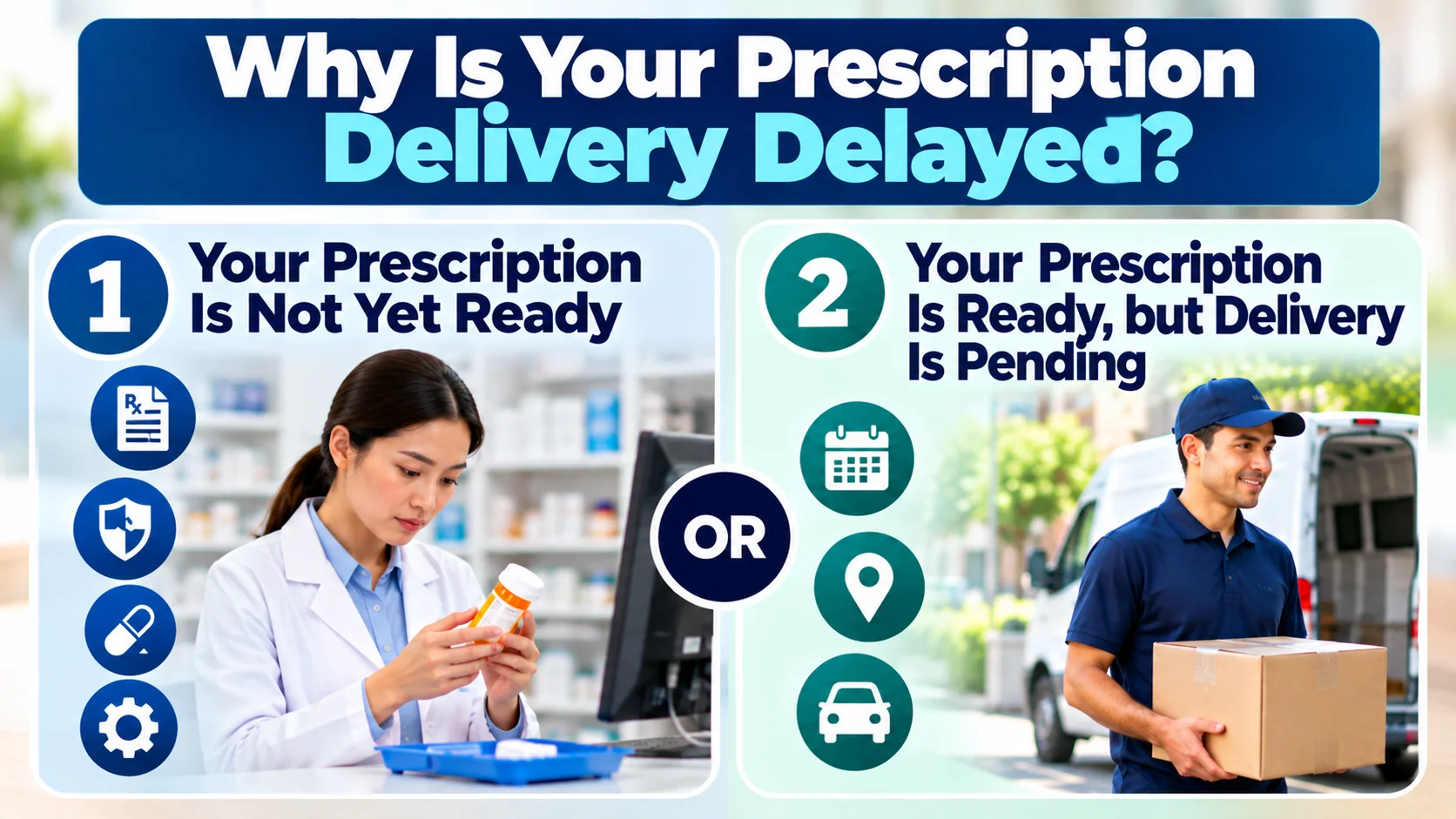
Is Your Prescription Still Being Prepared, or Is the Delivery Running Late?
The first step is understanding where the delay occurred.
Prescription not ready: The pharmacy may still be processing the prescription or resolving a requirement before it can be dispensed.
Prescription ready, delivery pending: The medication may be prepared, but delivery scheduling, access, or transportation is delaying its arrival.
These situations require different next steps. If the prescription is not ready, the pharmacy can explain what remains unresolved. If it is ready, the pharmacy can help clarify the delivery arrangements.
Can Insurance Problems Delay a Prescription Delivery?
Sometimes. A pharmacy may encounter a coverage rejection, an early-refill restriction, or a requirement for prior authorization.
These issues concern the prescription’s coverage or processing, rather than the transportation of the medication.
Insurance coverage varies by medication and plan. Patients may need to clarify whether their prescribed medicine is covered.
Ask the pharmacy whether an insurance issue is holding up the prescription and whether you or your prescriber need to take any action.
Do not assume that a delivery delay means your insurance has been canceled or that the prescription has been denied permanently.
What If the Pharmacy Does Not Have the Medication Available?
A prescription may take longer to prepare if the medication is temporarily unavailable from the pharmacy’s existing inventory or distributor.
A local supply problem is not necessarily a nationwide drug shortage.
If availability is causing the delay, ask the pharmacist what is known about the expected supply and whether your prescriber needs to be involved.
Do not substitute a different medication, strength, or dosage form on your own.
Why Might Delivery Be Late Even When the Prescription Is Ready?
Once the pharmacy has prepared a prescription, several practical issues can affect its arrival.
These may include delivery scheduling, traffic, weather, difficulty reaching the destination, an incomplete address, or access to an apartment building.
A prescription being ready does not necessarily mean it has already left the pharmacy.
If you live in a building with an intercom, entrance restrictions, or other access requirements, confirm that the pharmacy has the necessary delivery information.
If a family member or caregiver will receive the medication, make arrangements with the pharmacy in advance. For more information, see Can Someone Else Receive Your Prescription Delivery?.
What Should You Do If Your Prescription Delivery Has Not Arrived?
Contact the pharmacy directly and ask for a status update.
If the prescription is still being processed, ask what remains outstanding. If it is ready, ask about the delivery arrangements.
Avoid sending sensitive prescription or insurance information through public social media comments or messages.
The most useful questions are:
- Has my prescription been filled and prepared?
- Is there an insurance, refill, or medication-availability issue?
- Has the prescription been scheduled for delivery?
- Do you need to confirm my address or delivery arrangements?
- What is the next step, and when should I check back?
What If You Are Running Out of Medication While Waiting?
A delay may be more concerning when you have little or no medication remaining.
Tell the pharmacist how much medication you have left and when your next dose is due. The pharmacist can help determine the appropriate next step and whether your prescriber should be contacted.
Do not double doses, change your schedule, or substitute another medication to compensate for a delay unless a qualified healthcare professional directs you to do so.
If you have already missed medication or are experiencing symptoms, seek timely professional advice. For severe or emergency symptoms, seek emergency medical care.
The appropriate response depends on the medication and your individual circumstances.
How Can You Reduce the Chance of Future Prescription Delivery Delays?
Not every delay can be prevented, but a few preparation steps may help.
Request routine refills with sufficient lead time, particularly if your prescription has no refills remaining or requires insurance review.
Confirm that the pharmacy has your current delivery address and a reliable way to contact you.
If someone else will receive your prescription, ask about the arrangements before delivery day.
Our guide, What Should You Know Before Getting Prescriptions Delivered?, explains how to prepare for a delivery.
Patients who manage several ongoing prescriptions may also want to learn about medication synchronization, which can help coordinate eligible refill schedules. It does not guarantee that every medication will be ready or delivered together.
Prescription Delivery Questions at ABC Drugs
ABC Drugs offers free same-day local prescription delivery for eligible prescriptions within its service area.
Same-day delivery depends on prescription readiness, eligibility, and delivery arrangements. It should not be interpreted as an unconditional guarantee that every prescription can arrive the day it is requested.
If your delivery has not arrived as expected, contact ABC Drugs to clarify whether the prescription is still being prepared or whether the delivery itself is pending.
For service details, visit ABC Drugs Free Same-Day Local Prescription Delivery.
Once your medication arrives, you can also review What Should You Check When Your Prescription Is Delivered? and How Should You Store Prescription Medications After Delivery?.
Frequently Asked Questions
1. Why is my prescription delivery taking longer than expected?
The prescription may still be undergoing pharmacy processing, or a prepared prescription may be delayed during delivery. Contact the pharmacy to find out which stage is affected.
2. Does requesting a refill mean my prescription is ready for delivery?
No. A refill request may still require processing, insurance review, or prescriber authorization before the medication is ready.
3. Can prior authorization delay prescription delivery?
Yes. If an insurance plan requires prior authorization, the prescription may need additional review before coverage can be resolved.
4. What happens if my medication is out of stock?
Ask the pharmacy about availability and the next steps. If an alternative is being considered, the pharmacist and prescriber can determine what is appropriate.
5. Can traffic or weather delay an already-prepared prescription?
Yes. Transportation conditions and delivery scheduling can affect arrival even after the pharmacy has prepared the medication.
6. What if the delivery driver cannot enter my building?
Contact the pharmacy to confirm your address, entrance information, and any arrangements needed to receive the delivery.
7. Can someone else receive my prescription if I will not be home?
A family member or caregiver may be able to receive an eligible delivery, depending on the pharmacy’s requirements. Confirm the arrangement in advance.
8. What should I do if I am almost out of medication?
Contact the pharmacist promptly, explain how much medication remains, and ask about the appropriate next step. Do not independently change your prescribed regimen.
9. Does free same-day prescription delivery mean every medication will arrive today?
No. Delivery depends on prescription readiness, eligibility, and scheduling. Confirm the arrangements for your specific prescription with the pharmacy.
10. How can I find out when my delayed prescription will arrive?
Contact the pharmacy for the current status and ask whether the prescription is ready, scheduled for delivery, or awaiting another step.
Sources & References
- MedlinePlus — Getting a Prescription Filled. Background on prescription processing and insurance coverage.
- FDA — Frequently Asked Questions About Drug Shortages. Distinguishing local supply problems from broader shortages.
- FDA — Drug Shortages. Medication supply interruptions and availability.
- ABC Drugs — Pharmacy FAQs. Pharmacy-specific information about prescriptions and delivery.
Medical Disclaimer
This article is for general educational and informational purposes only and is not a substitute for personalized medical advice. Talk with your pharmacist or healthcare provider about questions concerning your medications or health conditions.