By ABC Pharmacy
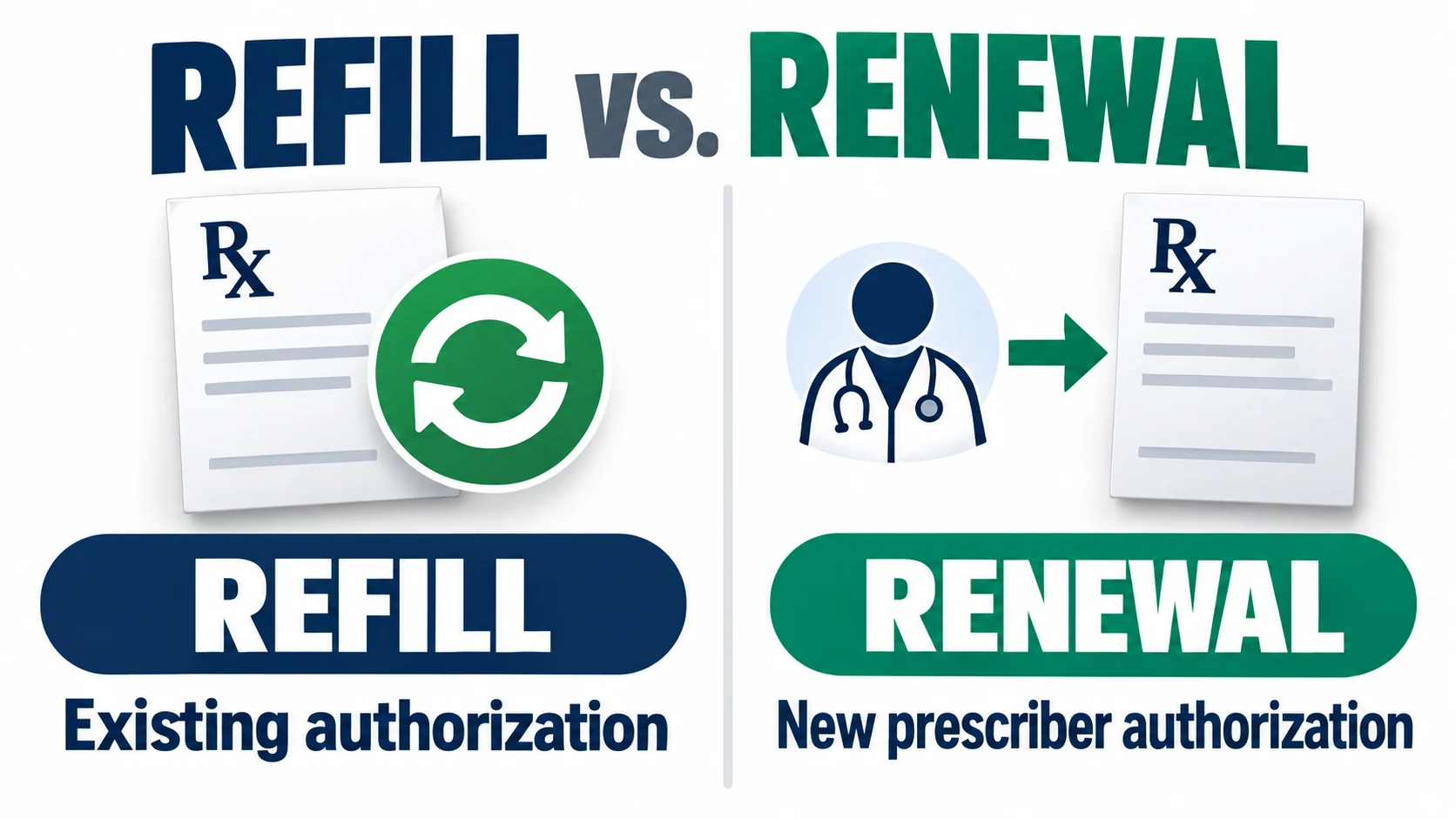
A prescription refill provides another supply using authorization already on a valid prescription. A renewal requires new authorization from your prescriber, usually when no refills remain or the prescription is no longer valid. If you are unsure which you need, ask your pharmacy to check the record and identify the next step.
What is the difference between a prescription refill and a renewal?
A refill uses authorization that already exists on a valid prescription. A renewal requires new authorization from your prescriber, commonly because the allowed refills are used up or the prescription is no longer valid for dispensing.
People sometimes call both requests “refills,” including in patient portals. The useful question is whether your pharmacy can use existing authorization or needs a response from your prescriber.
| Question | Refill | Renewal |
|---|---|---|
| What authorization is used? | Remaining authorization on a valid prescription. | New authorization from the prescriber. |
| Where can I start? | Ask your pharmacy to check the record. | Ask your pharmacy or follow your prescriber’s renewal process. |
| Is it automatically ready? | No. Processing and other requirements still apply. | No. Approval and pharmacy processing are separate steps. |
What does “0 refills remaining” mean?
It means the prescription record has no additional refills authorized under that order. It does not, by itself, tell you to stop treatment. Ask the pharmacy whether a newer prescription is already on file or whether the prescriber needs to authorize another supply.
For example, a prescription may authorize an initial fill plus two refills. Once those refills are used, continuing treatment generally requires new authorization. Your pharmacist can confirm the current record rather than relying only on an older bottle.
Our guide to reading a prescription label explains where to find prescription information.
Should I call my pharmacy or my prescriber first?
Start with the pharmacy if you are unsure whether valid refills remain. It can check the record and explain whether it can process the request or needs prescribing authorization.
Contact your prescriber when the pharmacy directs you to, when an office review is needed, or when you have questions about changing treatment. Follow the office’s process for controlled medications or other medicines with specific requirements.
Have the medication name, strength, prescription number if available, current directions, pharmacy details, and amount remaining ready. Tell the office if you recently changed pharmacies.
Why might my prescriber require an appointment before renewing?
Your prescriber may want to assess how treatment is working, review symptoms or side effects, or check monitoring such as blood pressure or lab results. A medicine intended for ongoing use can still require periodic follow-up.
If you are told a visit or test is needed, ask how to arrange it and what to do about your supply in the meantime. Do not assume a renewal request guarantees approval or that the next prescription will have unchanged directions.
How early should I request a refill or renewal?
Plan before your supply is nearly exhausted. Ask your pharmacy and prescriber how much lead time they need, particularly before weekends, holidays, travel, or delivery. A renewal can involve additional coordination.
There is no single turnaround time for every request. Ask what is pending and when to follow up. Submitting an early request does not necessarily mean the medication can be dispensed early.
Does prescriber approval guarantee insurance will pay?
No. Prescribing authorization and insurance approval answer different questions. A plan may still apply prior authorization, quantity limits, or refill-timing requirements. “Authorized to continue” does not necessarily mean “covered and ready today.”
Are controlled-medication refills different?
Yes. Schedule II prescriptions cannot be refilled; continued treatment requires a new prescription when appropriate. Other controlled medications have their own limits and requirements.
Do not apply a general refill timeline to every controlled medication. Ask the pharmacist and prescriber what is permitted for your specific prescription. An online request or an automatic reminder does not override those rules.
Do I need a renewal if I am switching pharmacies?
Not always. An eligible prescription with valid authorization may be transferred. A transfer does not add refills, extend authorization, or replace a needed renewal.
Read what happens to remaining refills when you transfer a prescription for the transfer-specific explanation. If new authorization is needed, tell the prescriber which pharmacy should receive it.
ABC Drugs’ prescription transfer service can help coordinate eligible transfers and identify when prescriber involvement is needed.
What should I do if I am running out while waiting?
Contact your pharmacist promptly and explain how much remains and when the next dose is due. If authorization is outstanding, contact your prescriber as directed and ask for a plan.
Stopping some medicines suddenly can be harmful. Do not ration, borrow, double, or change doses on your own. Ask what to do if a dose may be missed. Any temporary supply depends on the medication, applicable rules, and professional assessment; it is not guaranteed.
Useful question: “Is this waiting for a refill, new prescribing authorization, insurance approval, or stock—and who needs to act next?”
Frequently asked questions about prescription refills and renewals
Is a prescription renewal the same as a new prescription?
A renewal generally means new prescribing authorization to continue treatment. It may be issued as a new prescription. Confirm the medication, strength, and directions rather than assuming they are unchanged.
Can a pharmacist request a renewal for me?
The pharmacy may be able to send a request to your prescriber. Ask whether that request has been sent and whether your office requires you to contact it directly. Sending a request does not mean it has been approved.
Do I always need an appointment to renew a prescription?
Not always. Your prescriber decides whether a visit, monitoring, or another assessment is needed. Ask the office about its requirements before your supply is low.
Can a prescription have refills remaining but still be unusable?
Yes. A listed refill count is not the only requirement for dispensing. The prescription must still be valid under the applicable rules. Ask the pharmacist to review the current record.
Is prescription expiration the same as the medicine’s expiration date?
No. Prescription validity concerns whether the pharmacy may dispense under that order. The medicine’s expiration or beyond-use date concerns the supplied product. Ask your pharmacist which date you are looking at.
Does automatic refill enrollment renew my prescription?
It does not create prescribing authorization. A pharmacy may request a renewal as part of its process, but the prescriber still needs to authorize continued treatment when required.
Why does my portal say “refill” when I have no refills left?
Portal labels vary. The button may send a request for the care team to review rather than directly place an authorized refill. Check the request status and where the response will be sent.
Can I renew a prescription online?
Your prescriber may accept requests through a patient portal or another approved process. Availability and any required assessment depend on the practice and medication. A submitted request is not an approval.
Does “renewal approved” mean the medication is ready?
No. The pharmacy must receive and process the authorization and address any coverage, stock, or review issues. Confirm readiness with the pharmacy before traveling to collect it.
What if my prescriber has not answered the renewal request?
Ask the pharmacy when and where the request was sent, then follow up with the prescriber’s office if needed. State how much medication remains and ask for next steps. Do not wait silently if you may miss treatment.
Sources
- Express Scripts Pharmacy: Prescription Refills vs. Renewals
- Geisinger: Prescription Renewals, Refills and Expired Medicine
- OSF HealthCare: How to Refill a Prescription
- OSF HealthCare Health Library: Medication Refill
- New York State Education Department: Pharmacy Law, Article 137
- New York Public Health Law §3339: Controlled-Substance Refills
- New York State Education Department: Prescription Refills
- Medicare: Drug Plan Rules
This article is for general educational and informational purposes only and is not a substitute for personalized medical advice. Talk with your pharmacist or healthcare provider about questions concerning your medications or health conditions.