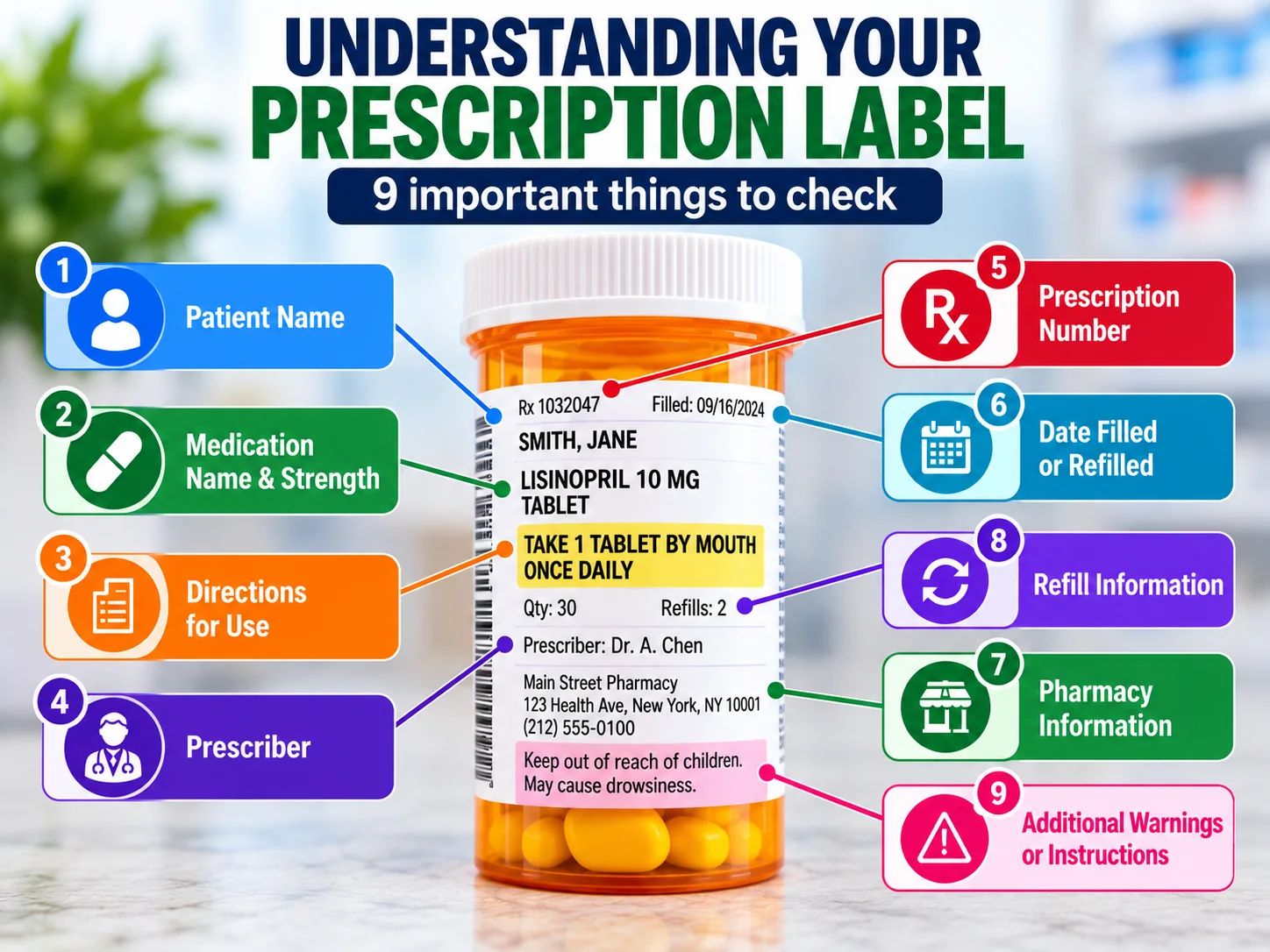
To read a prescription label, start with your name, the medication name and strength, and the complete directions. Then check the prescription number, prescriber, refill information, dates, and additional warnings.
Check these details whenever you receive a prescription, including refills. If something is unclear or unexpected, ask your pharmacist to verify it before using the medicine.
Key Takeaways
- Check that the prescription belongs to you and contains the medicine you expected.
- Strength describes the medicine; dose describes the amount you use.
- Read the complete directions and any accompanying instructions.
- The Rx number identifies a prescription—it is not your dose.
- A fill date is different from an expiration or discard date.
- “No refills” does not automatically mean your treatment should stop.
What Information Is on a Prescription Label?
A prescription label is the label the dispensing pharmacy places on your medication container or package. Its layout can vary, so information may appear in different places.
| Label information | What it means |
|---|---|
| Patient name | Who the medicine is prescribed for |
| Medication name | Which medicine was dispensed |
| Strength | The amount or concentration of medicine in the dosage form |
| Directions | How much to use, how to use it, and how often |
| Prescriber | The healthcare professional who prescribed it |
| Rx or prescription number | The number identifying the prescription in the pharmacy’s records |
| Fill or refill date | When the pharmacy filled the prescription |
| Refill information | Whether additional refills remain authorized |
| Pharmacy information | Which pharmacy dispensed it and how to contact that pharmacy |
| Additional warnings | Medicine-specific precautions or instructions |
In New York, prescription labels must emphasize the patient’s name, directions for use, and medication name and strength. Other required information includes the patient’s address, prescriber, pharmacy contact details, fill or refill date, and prescription identifier.
Check the Patient Name and Medication Name
Confirm that the label shows the correct patient. This is especially useful when collecting prescriptions for more than one household member.
Next, check the medication name and strength. If either differs from what you expected, ask the pharmacist to confirm the prescription.
If the medicine itself looks unfamiliar, have the pharmacy verify it. A change in appearance can have a legitimate explanation, but color or shape alone cannot establish its identity.
What Is the Difference Between Medication Strength and Dose?
Strength is the amount or concentration of medicine in a particular form. Dose is the amount you are instructed to take or use.
For a tablet, strength generally describes the amount of medicine in each tablet. For a liquid, it may describe the concentration.
The strength printed beside the medication name does not, by itself, tell you how many tablets to take or how much liquid to measure. Use the complete prescription directions and ask your pharmacist if the amount is unclear.
Read the Complete Directions for Use
Directions explain how the medicine was prescribed to be used. Depending on the prescription, they may include:
- The amount to take or use.
- How to administer it.
- How often to use it.
- Instructions involving food or dose spacing.
- How long to use it, when specified.
Do not rely on memory from an earlier prescription. Read the current instructions.
If the label refers to a separate schedule, make sure you have it. If it says “as needed,” ask which symptoms it is intended for and what limits apply. Ask about missed-dose instructions as well; these depend on the medicine. FDA guidance recommends understanding your directions and discussing questions before changing how you use a medication.
Find the Prescriber and Pharmacy Information
The prescriber is the healthcare professional who issued the prescription. If the listed name is unexpected, ask the pharmacy to explain.
The pharmacy information identifies where the medicine was dispensed and provides a way to contact that pharmacy. Keep the labeled container available when calling with questions so you can refer to the prescription details.
What Is the Rx Number on a Prescription Bottle?
The Rx number, or prescription number, identifies a particular prescription in the pharmacy’s records.
You may be asked for it when requesting a refill or discussing that prescription. It is different from the medication’s name, strength, and directions.
When contacting the pharmacy, having your name, medication name, and prescription number available can help identify the correct record.
What Does “No Refills” Mean?
“No refills” or “zero refills remaining” means no additional refills remain authorized under that prescription.
It does not, by itself, mean you should stop treatment.
If you expect to continue the medicine, contact your pharmacy before running out. Ask whether your prescriber needs to provide a new prescription or other authorization.
Do not change your treatment based only on the refill count.
Is the Fill Date the Expiration Date?
No. The fill date records when the pharmacy filled the prescription. An expiration, discard, or use-by date addresses how long the medicine should be used.
Read the wording beside each date rather than assuming all dates mean the same thing.
If you cannot identify the relevant use-by or discard information, ask your pharmacist. Do not calculate it yourself from the fill date.
Check Warning Stickers and Accompanying Instructions
Additional stickers or patient information may explain precautions, storage, or other instructions specific to your medicine.
Read the words on the warning rather than relying on the sticker’s color. Also review any patient information or separate instructions supplied with the prescription.
If your prescriber’s instructions and the bottle label seem to conflict, ask your pharmacist or prescriber to confirm the current plan. Pharmacists can help explain medication information and address conflicting advice.
What Should You Check Before Leaving the Pharmacy?
Use this brief checklist when collecting a new prescription or refill:
- Patient: Is the prescription for the correct person?
- Medicine: Are the medication name and strength what you expected?
- Directions: Do you understand the amount, method, and frequency?
- Additional information: Have you read the warnings and received any separate instructions?
- Questions: Has the pharmacist clarified anything unfamiliar or confusing?
If your prescription is delivered, make these checks when it arrives and contact the dispensing pharmacy with questions.
What If Your Prescription Label Is Hard to Read?
Tell your pharmacist if small print, unfamiliar terms, language barriers, or vision difficulties make the label difficult to understand. Ask what assistance is available.
You can also ask the pharmacist to explain the instructions, then repeat your understanding back to confirm that you have interpreted them correctly.
Questions to Ask Your Pharmacist
- How much should I take or use?
- What timing or spacing does this medicine require?
- Are there food or storage instructions?
- What should I do if I miss a dose?
- Which instructions apply if my treatment recently changed?
Understanding Labels When You Take Several Medications
Each prescription has its own instructions. Understanding those directions helps you build an accurate medication list and schedule.
Do not assume that several medicines can all be taken at the same time or organized in the same way. Ask your pharmacist which arrangements fit your prescriptions.
ABC Drugs offers medication packaging and synchronization for eligible prescriptions. Learn more about Medication Packaging & Management at ABC Drugs.
Packaging can support organization, but you still need to understand your current instructions and contact the pharmacy when prescriptions change.
Frequently Asked Questions
How do I read a prescription label?
Start with the patient name, medication name and strength, and complete directions. Then review the prescriber, Rx number, dates, refill information, and additional warnings.
What does Rx mean on a prescription label?
Rx refers to a prescription. The Rx number identifies a particular prescription in the pharmacy’s records; it is not a dose.
What is the difference between strength and dose?
Strength describes the amount or concentration of medicine in a dosage form. Dose describes the amount you are instructed to take or use.
Does “twice daily” mean every 12 hours?
Ask your pharmacist what timing your prescription requires. Do not assume those phrases are interchangeable for every medicine.
Does “no refills” mean I should stop taking the medicine?
No. It describes the remaining refill authorization, not whether your treatment should end. Contact your pharmacy to find out what is needed next.
What should I do if the label differs from my prescriber’s instructions?
Ask your pharmacist or prescriber to clarify the current directions before using the medicine according to an uncertain instruction.
What if the medicine looks different from my last refill?
Ask the pharmacy to verify it before taking it. A different appearance may have a legitimate explanation, but appearance alone cannot confirm the medicine.
Sources & References
This article was developed using current guidance and information from authoritative health and medical sources.
- New York State Education Department — Part 63, Section 63.12: Patient-Centered Prescription Label ElementsNew York requirements for critical and important prescription label elements.
- MedlinePlus — Medicine Safety: Filling Your PrescriptionChecking prescription details, identifying prescriptions for refill requests, and verifying unfamiliar medicines.
- U.S. Food and Drug Administration — Think It Through: Managing the Benefits and Risks of MedicinesUnderstanding medication directions and discussing timing, storage, and missed-dose questions with healthcare professionals.
- U.S. Food and Drug Administration — Pharmacists Help You Use Medicines SafelyPharmacists’ role in explaining medication instructions and addressing conflicting information.
- Institute for Safe Medication Practices — Anatomy of a Prescription LabelLabel fields, warnings, refill information, and the distinction between fill and discard dates.