Direct Answer
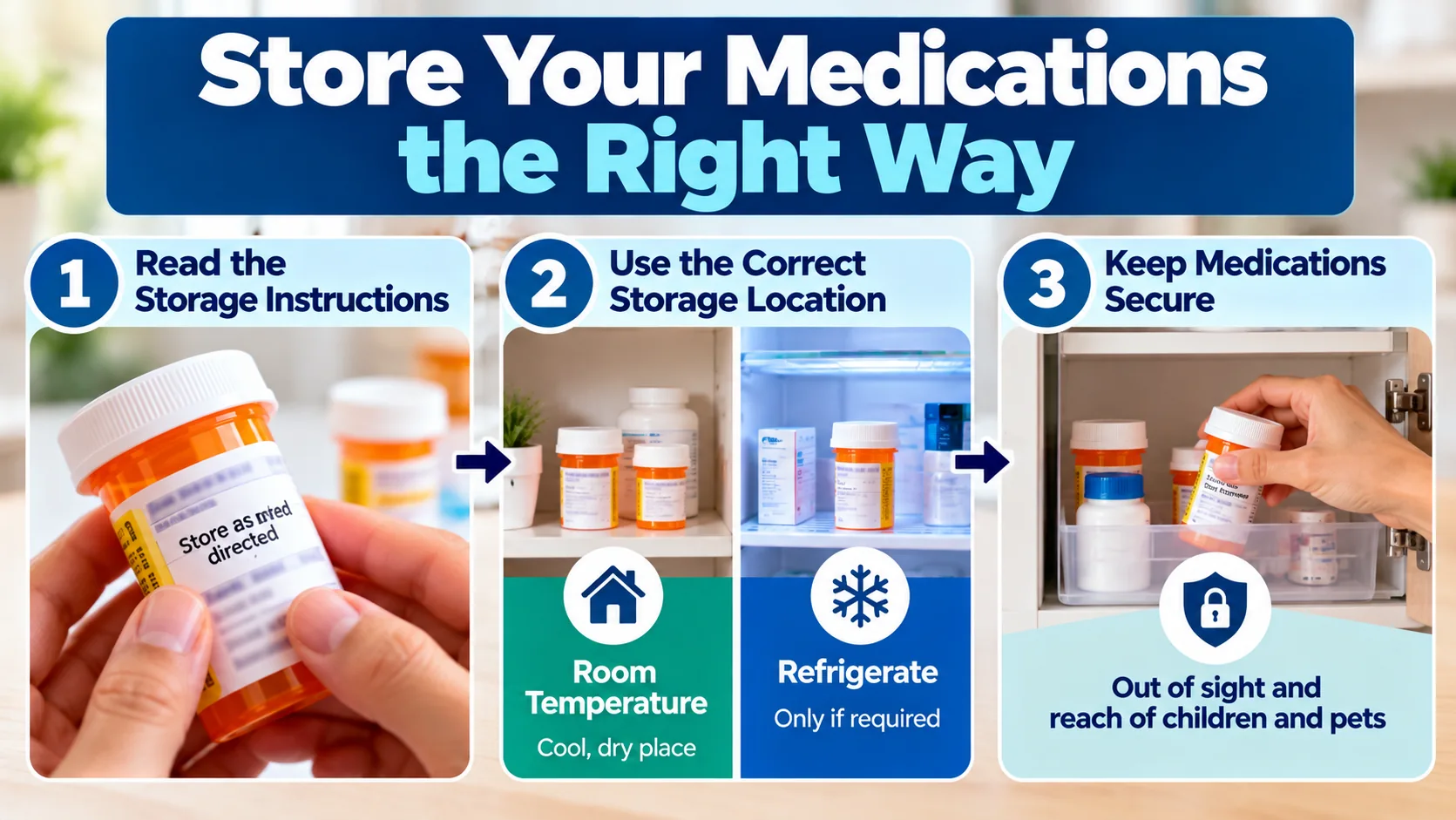
After receiving a prescription delivery, read the medication’s storage instructions and put it in the appropriate location promptly. Many medications should be kept in a cool, dry place, away from excess heat, moisture, and direct sunlight. Some require refrigeration or other special conditions.
Keep medications in their original labeled containers unless your pharmacist has provided an appropriate alternative. Store them securely, out of sight and reach of children and pets.
If you are unsure how a medication should be stored—or believe it was exposed to excessive heat, cold, or moisture—contact your pharmacist before using it.
Key Takeaways
- Check each medication’s storage instructions rather than assuming all prescriptions are stored the same way.
- Keep most room-temperature medications in a suitable cool, dry location.
- Refrigerate medications only when their specific instructions require it.
- Keep medications in their original labeled containers unless advised otherwise.
- Store all medications securely, away from children and pets.
- Ask your pharmacist about possible temperature damage rather than guessing whether a medication is still usable.
1. What Should You Do Immediately After Your Prescription Arrives?
Before putting your prescription away, take a moment to review the medication and its storage instructions.
First, confirm that the delivery contains the medication intended for you. Check the patient name, medication information, and package condition.
If you need help with those checks, see our guide, What Should You Check When Your Prescription Is Delivered?
Next, look for storage instructions on the prescription label, packaging, or accompanying patient information. A medication that requires refrigeration may need to be placed in the refrigerator promptly. Another medication may need to remain at room temperature.
The correct storage location depends on the specific medication—not simply whether it was delivered.
2. Where Should You Store Medications That Do Not Require Refrigeration?
Many medications are intended to be stored at room temperature in a cool, dry location.
Depending on the medication and your home environment, an appropriate location may be a bedroom drawer, a secure closet, or a cabinet away from sources of heat and moisture.
Avoid storing medications near stoves, sinks, radiators, or other areas where conditions may change significantly.
Is the bathroom medicine cabinet a good place?
Not necessarily. Bathrooms can become warm and humid during showers and baths. Repeated exposure to heat and moisture can affect some medications.
MedlinePlus recommends a cool, dry storage location and cautions against bathroom moisture for many medicines.
If your medication has particular storage requirements, follow those instructions instead of relying on general advice.
3. What If Your Prescription Medication Needs Refrigeration?
Some medications require refrigerated storage. Others must remain at room temperature or have additional handling requirements.
Do not refrigerate a medication unless its instructions call for it.
When a refrigerated medication arrives, follow the specific storage directions promptly.
Do not assume that freezing is acceptable. Certain medications can be damaged by freezing, even when they normally require refrigeration.
If you are unsure about the correct temperature or where to place the medication in your refrigerator, ask your pharmacist.
4. Why Should You Keep Medications in Their Original Containers?
A prescription container provides important information, including the medication name, patient name, directions, and other labeling details.
Keeping medications in their original labeled containers can help reduce confusion, especially when several people in a household take prescription medicines. It also makes it easier to check storage instructions and identify a medication if you need to speak with a pharmacist.
Some patients use pharmacist-prepared medication packaging to help organize multiple prescriptions. Such arrangements should be made with the pharmacy, because not every medication is suitable for the same type of packaging.
For help organizing a medication routine, read How to Keep Track of Multiple Medications.
Do not transfer medications into unlabeled containers or combine different prescriptions without appropriate pharmacist guidance.
5. How Can You Store Medications Safely Around Children and Pets?
Medications should be stored securely, out of sight and reach of children and pets.
A high shelf alone may not be sufficient, particularly when children can climb or access furniture. A locked cabinet or another secure storage location may be appropriate.
Remember that child-resistant packaging is not completely childproof.
Avoid leaving medication bottles, pill organizers, or delivery bags on countertops, bedside tables, or other accessible surfaces.
6. What If Your Medication Was Exposed to Heat, Cold, or Moisture?
You might be concerned if a delivery sat in a warm area, was exposed to freezing temperatures, or arrived with damaged packaging.
Whether a medication remains usable depends on the particular product, the conditions involved, and how long the exposure lasted.
A medication may not show visible changes even when improper storage has affected its quality.
Do not assume a medication is safe simply because it looks normal.
If you suspect a storage problem:
- Keep the medication and its packaging available for review.
- Contact the pharmacist and explain the circumstances.
- Ask whether the medication can still be used or requires further evaluation.
- Do not use a medication you suspect has been compromised until the concern has been resolved.
Do not attempt to correct possible temperature damage by freezing, heating, or otherwise changing the medication's storage conditions.
7. What If a Family Member or Caregiver Receives the Delivery?
If someone else receives a prescription on your behalf, it is important that the medication reaches the intended patient and is stored appropriately.
A family member or caregiver may need to know whether the prescription has special storage requirements.
However, the ability to receive another person's medication is not automatic. Recipient arrangements should be confirmed with the pharmacy in advance.
For more information, see Can Someone Else Receive Your Prescription Delivery?.
Caregivers should avoid guessing about storage conditions or transferring medications into different containers without guidance.
8. What Storage Questions Should You Ask Your Pharmacist?
You can ask your pharmacist:
- Does this medication need refrigeration?
- Should I protect it from light or moisture?
- Can I store it in a pill organizer or medication package?
- What should I do if it was exposed to excessive heat or cold?
- Are there special instructions after opening the container?
- How should I store it safely if children or pets live in my home?
The answers may differ depending on the medication and its formulation.
ABC Drugs offers pharmacist consultation for questions about medication use, handling, and storage.
9. ABC Drugs Prescription Delivery and Medication Storage
ABC Drugs provides free same-day local prescription delivery for eligible prescriptions in its service area.
Before arranging delivery, patients can ask whether their medication requires special handling or whether someone needs to be available to receive it.
Our guide, What Should You Know Before Getting Prescriptions Delivered?, explains how to prepare for a prescription delivery.
For information about delivery availability and service details, visit ABC Drugs Free Same-Day Local Prescription Delivery.
Frequently Asked Questions
1. Should I refrigerate my prescription as soon as it arrives?
Only if the medication’s storage instructions require refrigeration. Other medications may need room-temperature storage.
2. Is it safe to keep medications in the bathroom?
Bathrooms can become hot and humid. Many medications are better stored in a cool, dry location, unless their specific instructions say otherwise.
3. Can I leave my prescription delivery on the kitchen counter?
Avoid leaving medication where children or pets could reach it or where it may be exposed to heat, sunlight, or moisture. Follow the medication’s storage instructions.
4. What if my medication was left in a hot area?
Contact your pharmacist with details about the medication and possible temperature exposure. Do not assume it remains usable.
5. Can I freeze medication that normally needs refrigeration?
Do not freeze medication unless its specific instructions permit freezing. Some refrigerated medicines can be damaged by freezing.
6. Should I remove medications from their prescription bottles?
Generally, keep medications in their original labeled containers unless your pharmacist has arranged or approved another suitable method.
7. Can all medications go into a pill organizer?
No. Some medications have storage or packaging requirements that make a standard pill organizer unsuitable. Ask your pharmacist before transferring them.
8. What if my family member receives a refrigerated prescription?
The recipient should follow the medication’s specific storage instructions promptly. Arrange recipient and handling requirements with the pharmacy in advance.
9. How do I know if medication has been damaged by improper storage?
Visible changes may be a warning sign, but damage is not always visible. Ask your pharmacist if you suspect improper storage.
10. Where should I store medications if children or pets live with me?
Use a secure location out of sight and reach, preferably locked when appropriate, while also meeting the medication’s temperature and storage requirements.
Sources & References
- MedlinePlus — Storing Your Medicines. Guidance on heat, moisture, original containers, secure storage, and possible damage.
- U.S. Food and Drug Administration — 5 Medication Safety Tips for Older Adults. Medication safety and storage guidance.
- ABC Drugs — Free Same-Day Local Prescription Delivery. Pharmacy delivery service information.
Medical Disclaimer
This article is for general educational and informational purposes only and is not a substitute for personalized medical advice. Talk with your pharmacist or healthcare provider about questions concerning your medications or health conditions.