Medication synchronization, often called Med Sync, coordinates refill dates for eligible ongoing prescriptions. It can bring medicines that are due at different times into a more consistent refill schedule.
Getting started may require an initial adjustment. Your pharmacist reviews the prescriptions, remaining refills, insurance requirements, and medication-specific rules. Not every medicine can necessarily follow the same refill date.
Key Takeaways
- A shorter initial fill may sometimes help align eligible refill dates.
- Synchronization changes refill timing, not your prescribed dose.
- Med Sync, automatic refills, and blister packaging serve different purposes.
- Tell your pharmacy when a medicine or its instructions change.
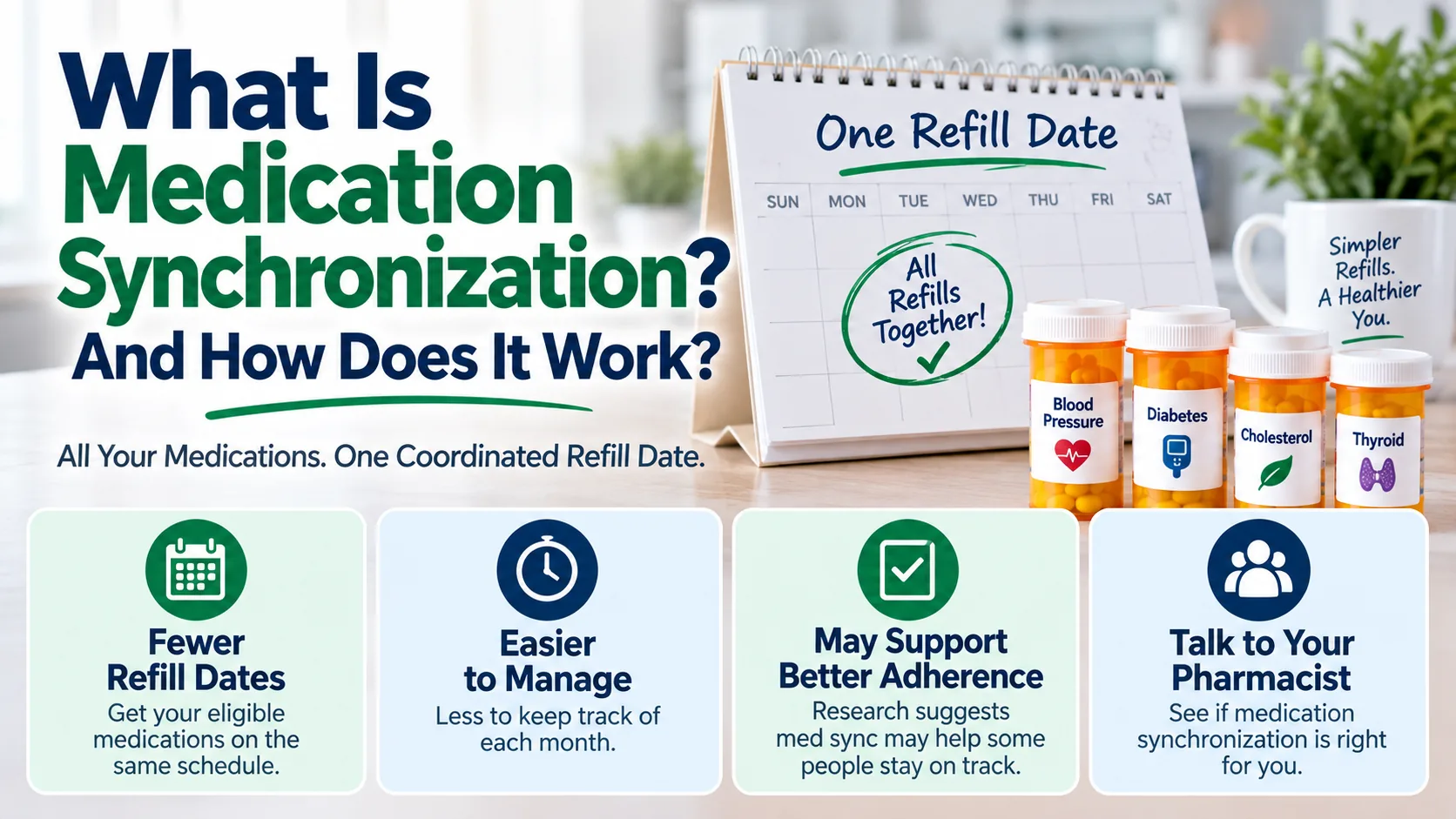
What Is Medication Synchronization?
Med Sync is refill coordination for eligible ongoing medicines. Its central purpose is to align refill dates rather than leave each prescription on an unrelated schedule.
Programs may also include medication review, advance patient contact, and arrangements for collecting prescriptions. These features vary by pharmacy.
How Does Medication Synchronization Work?
The pharmacy reviews your ongoing prescriptions, identifies which may be synchronized, and develops a refill-alignment plan.
Some appointment-based programs contact patients before preparing refills to confirm what is needed and identify prescription changes. Ask your pharmacy how its own process works.
A Simple Example
Imagine three eligible prescriptions with different refill dates. The pharmacy may adjust an initial supply of one or more medicines so later refills fall closer together. This is an illustration, not a guaranteed process for every prescription or insurance plan.
How Are Different Prescription Refill Dates Synchronized?
A shorter initial fill can sometimes provide enough medicine to reach a coordinated refill date. The pharmacist determines whether this approach is appropriate.
Do not take less medicine or skip doses to align refills. A short fill changes the quantity dispensed; it does not change the prescribed directions.
New York coverage note: State Insurance Law § 3224-d provides for qualifying synchronization short fills with prorated cost sharing under applicable prescription coverage. Conditions include covered chronic medicines with refills, applicable authorization requirements, suitable formulations, and specific controlled-substance restrictions.
Ask your pharmacist how your coverage applies; this does not guarantee that every prescription or plan qualifies.
Which Medications Can Be Included?
Eligibility depends on the medicine, ongoing treatment needs, remaining refill authorization, prescribed supply, insurance requirements, and applicable pharmacy rules.
For NYRx members: New York Medicaid’s synchronization program targets maintenance medicines with the same day supply. Its guidance excludes controlled substances and medicines used for acute or short-term therapy.
Your pharmacist can assess your actual prescriptions. Some medicines may remain on separate schedules.
What Are the Potential Benefits?
Fewer Separate Refill Dates
A coordinated schedule may simplify tracking eligible refills and arranging pharmacy visits.
Possible Support for Medication Adherence
Medication adherence means taking medicines as prescribed. A 2021 meta-analysis of nine U.S. studies found an association between synchronization and greater odds of adherence in adults taking chronic medicines.
The studies and programs differed substantially, and study quality was rated fair. These findings do not guarantee fewer missed doses or better health outcomes for every person.
Medication Synchronization vs. Automatic Refills: What’s the Difference?
Synchronization coordinates refill dates. Automatic refill concerns how a refill is initiated. A coordinated date does not automatically authorize a refill.
NYRx specifically states that synchronization refills are not eligible for automatic refill. Ask how your pharmacy confirms which prescriptions you need before preparing them.
Medication Synchronization vs. Blister Packs: What’s the Difference?
Synchronization organizes when eligible prescriptions are refilled. Blister packaging organizes how eligible medicines are arranged for their prescribed schedule.
They may be used together when appropriate. Synchronized refills do not automatically include blister packs, and packaged medicines do not necessarily all share one refill date.
What Happens if a Prescription Changes?
A new medicine, dose change, changed frequency, or discontinued prescription can affect your refill schedule.
Tell the pharmacy about the change so it can review upcoming refills. Do not assume the previous arrangement remains correct.
New York’s synchronization law also recognizes certain repeat alignment adjustments after changes in dosage, frequency, or the prescribed drug.
Who Might Find Medication Synchronization Helpful?
It may suit someone managing several eligible ongoing medicines with inconveniently scattered refill dates.
The decision should reflect your prescriptions and routine. It is not necessary or appropriate for everyone.
Questions to Ask Your Pharmacist
- Which prescriptions are eligible?
- Will a shorter initial fill be needed, and how will my copay work?
- How will refills be confirmed and readiness communicated?
- What should I do when a prescription changes?
- Could packaging and synchronization be used together?
ABC Drugs offers synchronization and packaging options for eligible prescriptions. Learn more about Medication Packaging & Management at ABC Drugs.
Frequently Asked Questions
Do all my prescriptions have to be synchronized?
No. Eligible ongoing prescriptions can be coordinated while other medicines remain on separate schedules.
Can controlled substances be synchronized?
NYRx excludes controlled substances from its synchronization program. New York’s insurance-law provision also has specific restrictions. Ask your pharmacist about the medicine and coverage involved.
Does Med Sync automatically refill my prescriptions?
Not necessarily. Refill alignment and refill authorization are different. NYRx synchronization refills are not eligible for automatic refill.
What if my doctor changes a prescription?
Tell your pharmacy. The change may affect upcoming refills and require adjustment of the schedule.
Can I use Med Sync with blister packs?
Potentially, when prescriptions are suitable for both. Your pharmacist can review refill alignment and packaging separately.
Sources & References
This article draws on professional pharmacy guidance, medication-adherence research, and New York program and legal sources.
- American Pharmacists Association Foundation — Pharmacy’s Appointment-Based ModelRefill alignment, initial supply adjustments, and advance patient contact in appointment-based programs.
- Nsiah I, et al. — The Impact of Medication Synchronization Programs on Medication Adherence: A Meta-analysisJournal of the American Pharmacists Association, 2021. Adherence associations, study quality, and variation across programs.
- New York State Department of Health — Medication Synchronization Program ImplementationSeptember 2024 Medicaid Update. NYRx maintenance-medication eligibility, exclusions, and automatic-refill restriction.
- New York State Insurance Law § 3224-d — Prescription SynchronizationQualifying short fills, prorated cost sharing, restrictions, and certain repeat alignment adjustments.