Quick Answer: When Should You Talk to a Pharmacist?
Ask a pharmacist before taking a new medication if the instructions are unclear, before combining medicines or supplements, and whenever you are unsure about a missed dose or medication change. Contact a pharmacist or prescribing clinician promptly for new or concerning symptoms that may be medication-related. If you have severe breathing difficulty, swelling of the tongue or throat, or another potentially life-threatening symptom, call 911 instead of waiting for a consultation.
Key Takeaways
- Before taking it: Check unclear instructions, unexpected medication appearance, or possible interactions.
- Promptly: Discuss new or worsening symptoms and medication problems that could interrupt treatment.
- Emergency: Call 911 for potentially life-threatening symptoms; do not wait for a pharmacy callback.
- Missed-dose and treatment-change decisions depend on the specific medication; do not assume doubling or stopping is safe.
It is not always obvious whether a medication question can wait until your next refill or needs attention sooner. The goal is to identify when to talk to a pharmacist and when the right next step is a prescribing clinician or emergency service. The examples below are general guidance, not a way to diagnose symptoms or assess an individual emergency.
When Should You Ask a Pharmacist, Contact a Clinician Promptly, or Call 911?
Use the situation—not simply the number of medicines you take—to decide when to seek help. If you are uncertain about the urgency of a symptom, seek timely medical assessment.
| Situation | Recommended next step |
|---|---|
| New prescription with unclear directions | Ask the pharmacist before taking it so you understand the prescribed instructions. |
| Considering an OTC medicine, vitamin, or supplement | Check with the pharmacist before combining products, particularly if you take other medicines or have medical conditions. |
| Missed dose or confusion about timing | Ask for medication-specific guidance; do not automatically double a dose. |
| New, persistent, or worsening symptom after starting or changing a medicine | Contact a pharmacist or prescribing clinician promptly for assessment and next steps. Some symptoms require more urgent evaluation. |
| Medicine looks different and you cannot verify it | Have the pharmacy check the medication before taking it. |
| Severe breathing difficulty, tongue or throat swelling, collapse, or other potentially life-threatening symptoms | Call 911 immediately. Do not wait for a pharmacist consultation. |
How to use this table: If a concern fits more than one category, follow the more urgent recommendation. If you cannot tell how serious a symptom is, seek timely medical evaluation rather than waiting for a routine refill or appointment.
These categories are not exhaustive. A pharmacist may refer you to a prescriber, urgent care, or emergency services depending on the circumstances.
If a medication question is time-sensitive and your pharmacy is closed or unavailable, contact your prescribing clinician, an appropriate urgent-care service, or emergency services based on the seriousness of the situation. Do not wait for a routine consultation when prompt assessment is needed.
Before Taking a Medication: Resolve Unclear Instructions or Interaction Questions
Some questions are best answered before the first dose: whether the label matches the directions you were given, how to take the medicine, or whether a new OTC product could interact with what you already use. Bring the actual package or ingredient list if you are asking about an OTC product or supplement. Do not assume that “nonprescription” means free of interactions.
If the medication looks different from your last refill and you are unsure what it is, ask the pharmacy to verify it. For help interpreting label details, read How to Read a Prescription Label.
For an overview of the consultation process rather than when to seek help, see What Is a Pharmacist Consultation?
If You Notice a Possible Medication Side Effect
If a symptom starts after a medicine is introduced or changed, note when it began and whether it is getting worse. Timing alone cannot establish the cause. Contact a pharmacist or prescribing clinician promptly for a concerning symptom; some symptoms need urgent assessment. A separate ABC Drugs guide will address suspected side effects in greater depth.
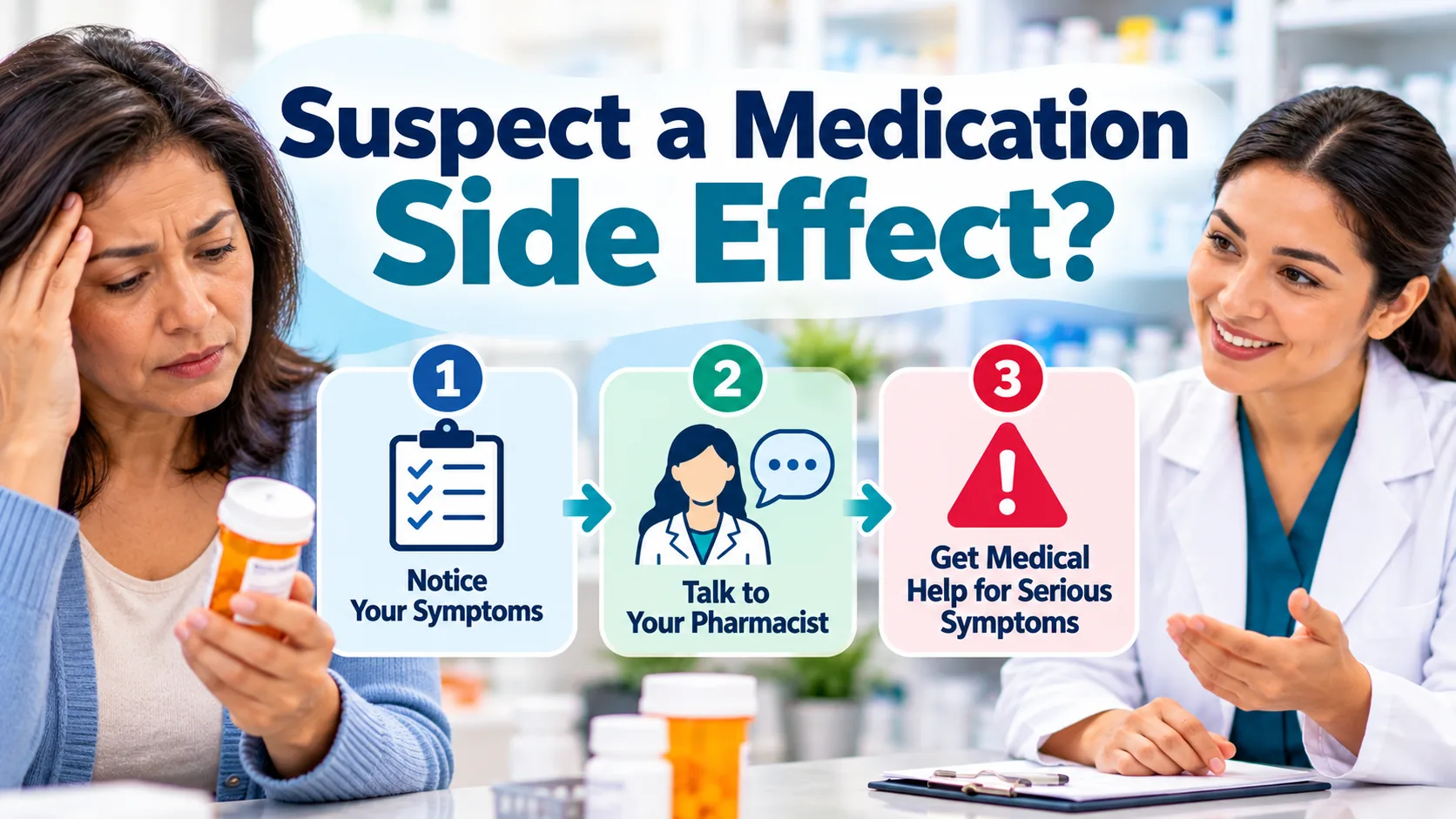
Do not ignore severe symptoms or delay emergency care. For non-emergency concerns, seek professional advice before independently stopping, restarting, or adjusting a prescribed medicine, unless you have already been given specific instructions for that situation. Some medicines require special precautions when stopped.
When it is an emergency
Call 911 for severe breathing difficulty, swelling of the tongue or throat, collapse, or other potentially life-threatening symptoms. A pharmacy consultation is not a substitute for emergency evaluation.
After a Missed Dose, Medication Change, or Refill Problem
The correct response to a missed dose depends on the medicine, timing, and your circumstances. Do not automatically double your next dose. Ask for medication-specific guidance, especially if you take a medicine where missed doses could be consequential.
Also seek guidance when a prescriber changes a dose, you start medicines from another clinician, or you cannot obtain a refill as expected. If a change creates a confusing schedule, your pharmacist can help clarify the directions and coordinate with your prescriber when needed. Patients managing multiple prescriptions may also benefit from our guide to keeping track of multiple medications.
What to Have Ready When You Contact Your Pharmacist
A brief, accurate description is more useful than trying to diagnose the problem yourself. When possible, have these details available:
- Exact product: Medication name, strength, and packaging or prescription label.
- Actual use: How you take it, including recent missed doses or changes.
- What happened: Your question or symptom, when it began, and whether it is worsening.
- Other products: Prescription medicines, OTC products, vitamins, and supplements.
- Relevant context: Allergies, medical conditions, and recent instructions from your prescriber.
Patients in Harlem and nearby Manhattan neighborhoods can learn about ABC Drugs' pharmacist consultation service. A pharmacist can answer medication-use questions and help determine whether a concern should be referred to a prescribing clinician. For cost or coverage barriers, see prescription insurance assistance.
Frequently Asked Questions
Can I ask a pharmacist a question even if I only take one medicine?
Yes. A single new prescription, confusing instruction, or potential interaction is a valid reason to ask.
What if I cannot remember whether I took my dose?
Ask for advice specific to your medication and schedule. Do not assume taking an extra dose is safe.
Should I call a pharmacist about a new rash after starting medication?
Seek prompt professional assessment because a new rash may require evaluation. If it occurs with breathing difficulty, tongue or throat swelling, collapse, or other signs of a severe reaction, call 911.
Can a pharmacist tell me whether a symptom is caused by my medicine?
A pharmacist can review known side effects and possible interactions, but the timing of a symptom does not establish its cause. Diagnosis or treatment changes may require a clinician.
What if my medication looks different after a refill?
Ask the pharmacy to verify the product before taking it if you are uncertain. Appearance changes can have legitimate explanations but should not be assumed safe without checking.
What if I cannot reach my prescriber about an important medication problem?
Tell your pharmacist what happened and ask what clinical follow-up is appropriate. If the problem is urgent or symptoms are worsening, seek timely medical care rather than waiting indefinitely for a callback.
Can a pharmacist help if instructions from two prescribers seem inconsistent?
Yes. Contact your pharmacist before guessing which directions to follow. Share both sets of instructions and the medication containers; the pharmacist may need to clarify the plan with your prescribers.
Sources & References
- U.S. Food and Drug Administration — Questions to Ask About Your Medicines
- MedlinePlus — Drug Information
- U.S. Food and Drug Administration — Drug Interactions: What You Should Know
- MedlinePlus — Anaphylaxis
Medical disclaimer: This article is for general educational and informational purposes only and is not a substitute for personalized medical advice. Talk with your pharmacist or healthcare provider about questions concerning your medications or health conditions.