What Should You Do If You Suspect a Medication Side Effect?
If you notice a new or unusual symptom while taking a medication, take it seriously without assuming the medication is definitely the cause. Record what you are experiencing, when it began, and which medicines you take. Contact your pharmacist or prescribing healthcare professional for medication-specific guidance, especially if the symptom is new, worsening, or interfering with daily activities.
Call 911 for potentially life-threatening symptoms such as severe trouble breathing, swelling of the tongue or throat, collapse, or loss of consciousness. Do not wait for a routine consultation. For other symptoms, do not independently stop, skip, double, or change prescribed doses; seek appropriate professional guidance. Serious suspected reactions may require emergency care and medication-specific instructions.
Key Takeaways
- A symptom that starts while taking a medicine is not automatically caused by that medicine.
- Side effects can begin at different times; some improve, while others persist or require medical attention.
- Seek emergency help for life-threatening symptoms and prompt professional advice for significant or worsening concerns.
- Prepare the medicine name, recent changes, symptom description, and timing before calling for advice.
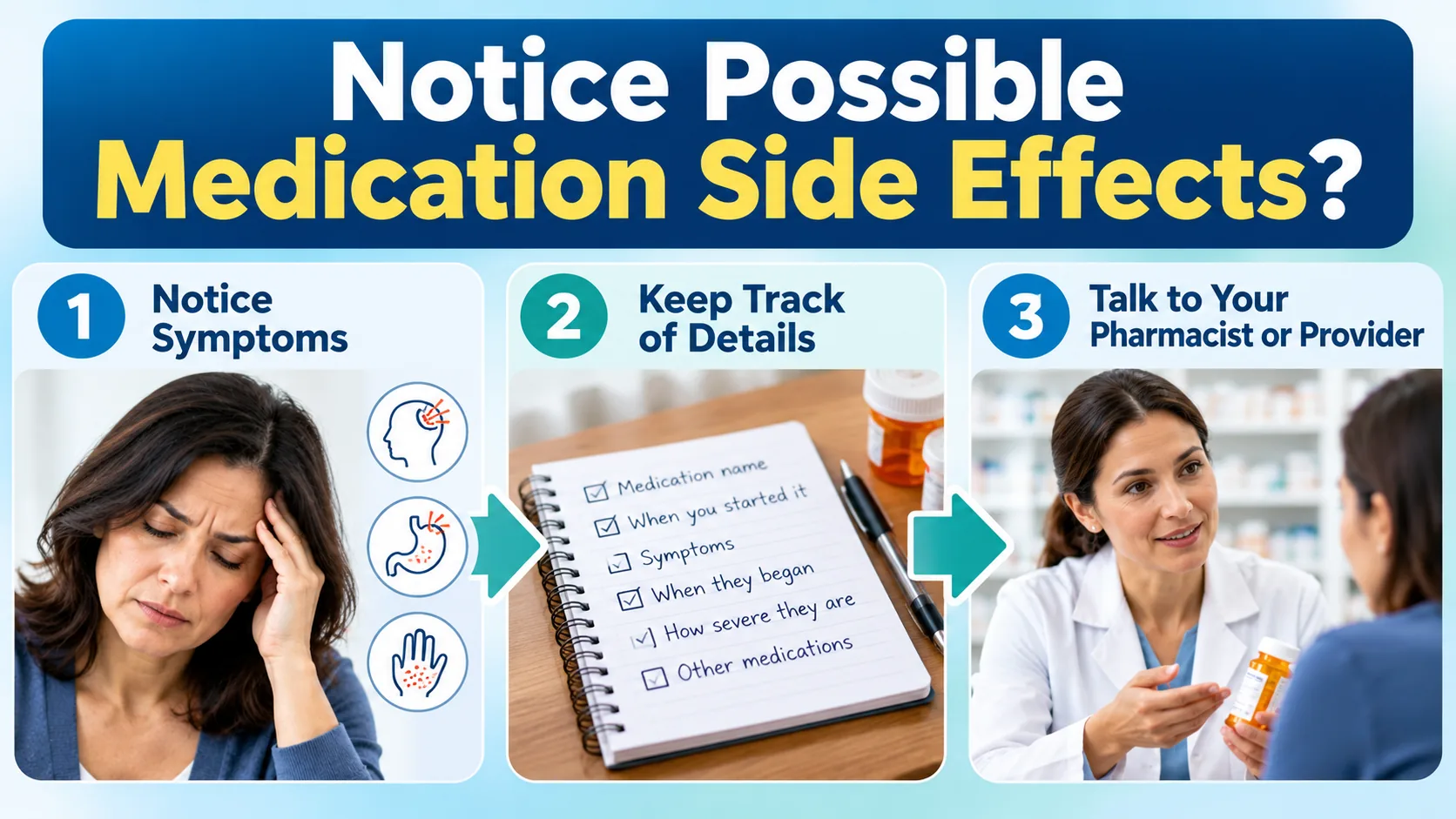
First Steps After Noticing a Possible Side Effect
First consider how severe the symptom is. A mild, stable concern and a rapidly worsening reaction need different responses. If you suspect an emergency, seek emergency care rather than trying to determine which medication caused the symptom.
- Describe the symptom. Write down what you feel, where it occurs, and whether it is changing.
- Note the timing. Record when it began, when you last took your medicine, and whether a medication or dose recently changed.
- List other relevant products. Include prescriptions, OTC medicines, supplements, and any recently added products.
- Ask for appropriate help. A pharmacist or prescriber can help assess medication-related concerns; some symptoms require urgent clinical evaluation.
You do not need to prove that a medication caused the symptom before seeking advice.
When Should You Seek Medical Help for a Suspected Side Effect?
The appropriate response depends on the symptom, severity, medicine, and individual health circumstances. The examples below are not a diagnostic checklist.
| Situation | Appropriate next step |
|---|---|
| Potentially life-threatening symptoms, including severe breathing difficulty, tongue or throat swelling, collapse, or loss of consciousness | Call 911 immediately. Do not wait for a pharmacy callback. |
| New, significant, persistent, or worsening symptoms that concern you | Contact a healthcare professional promptly. Some symptoms require urgent medical assessment rather than routine pharmacist counseling. If you cannot reach your usual clinician and the concern is significant, seek timely medical care. |
| Mild, stable, nonurgent concerns about a possible known effect | Discuss the specific medication and symptom with your pharmacist or prescriber to learn what to monitor and whether follow-up is needed. |
For a broader explanation of when pharmacist advice is appropriate, see When Should You Talk to a Pharmacist About Your Medication?
How Can You Tell Whether a Symptom Might Be Medication-Related?
One clue is that a symptom begins after starting a medication, changing a dose, or adding another product. But timing alone does not prove cause. Symptoms can also result from illness, an existing condition, an interaction, or an unrelated problem.
A pharmacist or prescriber may review known adverse effects, medication timing, other products, allergies, and medical history. Some symptoms require an examination or testing. Do not try to prove a side effect by stopping and restarting a prescription on your own.
How Soon Can Side Effects Start, and Do They Eventually Go Away?
How long after taking medication can side effects begin?
There is no single timeline. Some reactions occur soon after a dose, while others appear after days or weeks, following a dose change, or later during treatment. The timing depends on the medicine, reaction, and individual circumstances.
Do medication side effects eventually go away?
Some effects improve over time or after a healthcare professional adjusts treatment. Others persist, worsen, or require medical evaluation. Certain medication-related effects can be lasting. Do not assume a new symptom will disappear simply by waiting.
How long does it take for a side effect to wear off?
The duration depends on the specific symptom, medicine, dose, length of treatment, and health factors. It may not match the time it takes a medication to leave the body. Ask about the particular medicine rather than relying on a universal number of hours or days.
Should You Stop Taking Medication If You Have Side Effects?
Do not automatically stop, skip, double, or reduce prescribed doses without appropriate professional advice. Some medicines should not be stopped abruptly, while certain serious suspected reactions require immediate emergency assessment and medication-specific instructions.
For a potentially life-threatening reaction, call 911. For other concerning symptoms, contact your prescriber or pharmacist promptly and ask what to do about your next dose. If you cannot obtain timely advice and symptoms are significant or worsening, seek urgent medical evaluation.
What Information Should You Tell Your Pharmacist or Prescriber?
A short, accurate record can make the conversation more useful. You do not need to know the medical term for your symptom.
- Medication: name, strength, directions, and recent dose changes.
- Symptom: what happened, severity, onset, and whether it is improving or worsening.
- Timing: when you last took the medication and when the symptom appeared.
- Other products: prescriptions, OTC medicines, vitamins, and supplements.
- Relevant background: allergies, previous reactions, and relevant health conditions.
- Actions already taken: missed doses, other products used, or medical advice received.
For help identifying medication details, see How to Read a Prescription Label.
What Happens After You Report a Possible Side Effect?
Your pharmacist or prescriber may review the medication's known effects, other medicines, symptom timing, and relevant health history. Depending on the concern, next steps might include monitoring with specific instructions, clinical evaluation, testing, or a clinician-directed change in treatment. A pharmacist cannot diagnose the cause of every symptom from a conversation alone.
For nonemergency medication questions, ABC Drugs offers free pharmacist consultations at 2095 Madison Avenue, New York, NY 10037. To understand the consultation process, read What Is a Pharmacist Consultation?
Patients and healthcare professionals can report suspected medication-related adverse events through the FDA's MedWatch program. Reporting a suspected event does not prove causation and does not replace medical care.
Frequently Asked Questions
Can side effects start after taking the same medication for a long time?
Some medication-related problems can emerge later, particularly after changes in dose, other medicines, or health circumstances. A new symptom may also have an unrelated cause and deserves appropriate assessment.
How long does it take for your body to adjust to medication?
There is no universal adjustment period. Some effects improve, while others do not. Ask about the specific medicine and symptom, particularly if it is troublesome or worsening.
Can medication side effects be permanent?
Some medication-related effects can persist, although many are temporary. The risk depends on the medicine and type of reaction. Persistent or concerning symptoms warrant medical evaluation.
Who may be at higher risk for medication side effects?
Risk depends on the medicine, dose, health conditions, organ function, other medicines, and individual factors. Some older adults and people taking multiple medications face greater risks for certain adverse effects, but risk cannot be determined from age or medication count alone.
Can you recover from medication side effects at home?
There is no single safe home remedy for all side effects. Appropriate care depends on the medication and symptom. Seek professional advice for new or concerning symptoms and emergency help for life-threatening reactions.
Sources & References
- U.S. Food and Drug Administration: Tips for Talking With Your Pharmacist.
- U.S. Food and Drug Administration: Pharmacists Help You Use Medicines Safely.
- U.S. Food and Drug Administration: MedWatch Safety Reporting.
- National Library of Medicine, MedlinePlus: Drug Reactions.
Medical disclaimer: This article is for general educational and informational purposes only and is not a substitute for personalized medical advice. Talk with your pharmacist or healthcare provider about questions concerning your medications or health conditions.