Direct Answer
Your prescription copay or other out-of-pocket cost may increase because you are paying toward a deductible, your insurance plan changed its drug coverage or cost-sharing, your medication moved to a different formulary tier, or the quantity or pharmacy network changed. A higher amount at the pharmacy does not automatically mean the pharmacy raised its price. Ask your pharmacist to review the processed claim and your insurer to explain the benefit calculation.
Key Takeaways
- Patients often call every pharmacy payment a “copay,” but the amount may include a deductible or coinsurance.
- Insurance benefit changes, formulary tiers, deductible status, and prescription quantity can affect what you pay.
- The same medication can cost different amounts at different times, even without a change in your prescription.
- Ask whether the claim was processed through your current insurance and whether any coverage restriction applies.
- Do not stop or change medication because of a price increase without speaking with your healthcare team.
Why Did My Prescription Cost Go Up?
When you pick up a prescription, the amount you owe may be determined by several parts of your insurance benefit. Your plan may apply a fixed copay, a percentage of the medication's covered cost, or an amount toward your annual deductible. The result can change during the year.
It helps to distinguish the pharmacy's price, the insurance plan's payment rules, and the amount the patient owes. These are related, but they are not always the same. A higher amount at checkout does not by itself identify which factor changed.
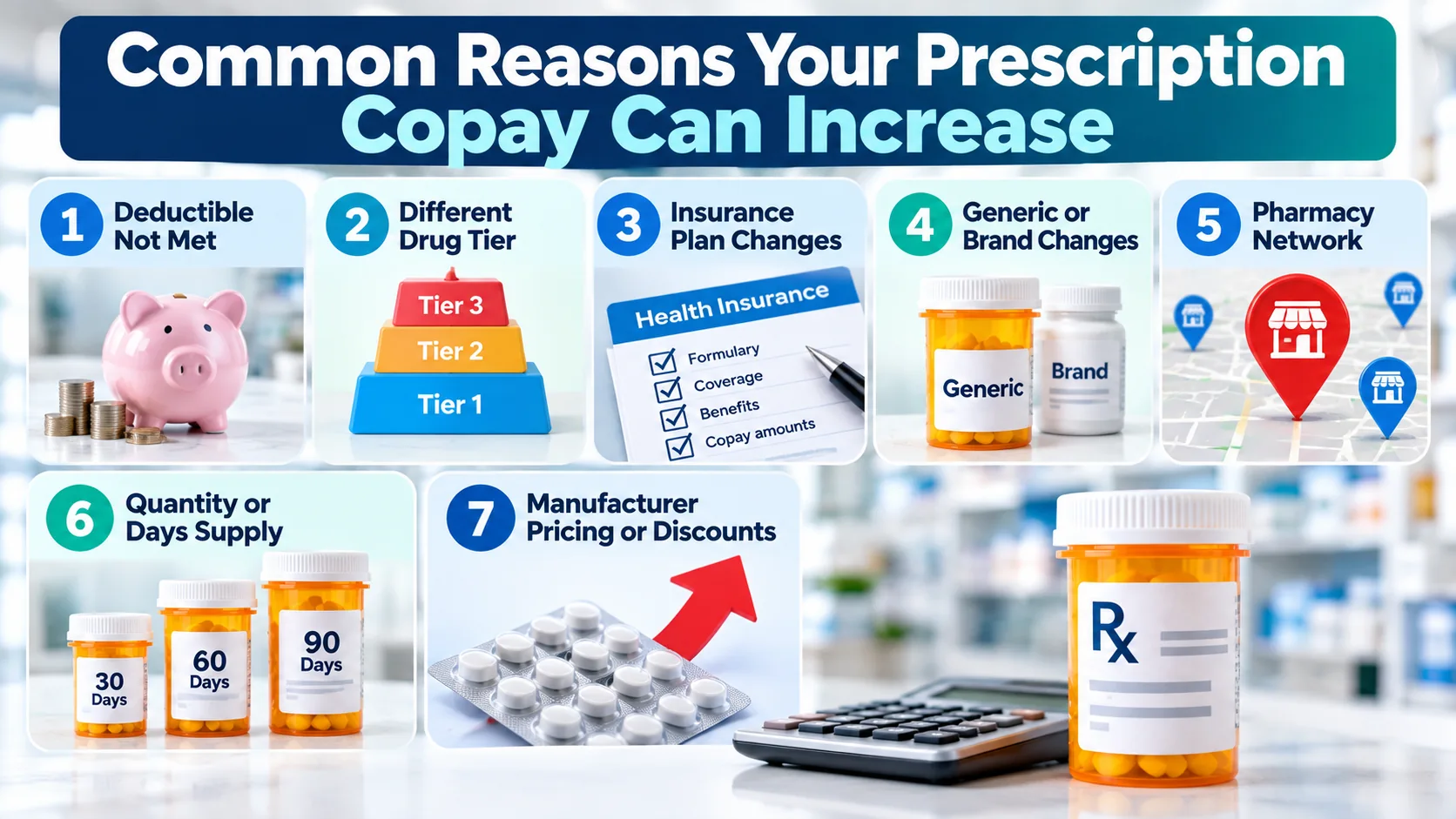
Seven Common Reasons Prescription Costs Increase
1. You are paying toward a deductible
Some plans require you to pay certain covered costs before a deductible is met. If a new plan year begins or you have not yet met the applicable deductible, you may owe more than you paid on a previous fill. Deductible rules vary by plan and drug.
2. Your medication's formulary tier changed
Insurance plans may place covered drugs into tiers with different cost-sharing requirements. If a drug moves to a tier with higher patient cost-sharing, your payment may increase. Plans can have different formularies and tier structures.
3. Your insurance benefits or plan changed
A new insurance plan, benefit year, employer coverage arrangement, or updated cost-sharing rule may change what you owe. Even if your insurance card looks similar, it is worth checking whether the prescription benefit is the same.
4. Your payment is based on coinsurance rather than a fixed copay
With coinsurance, your share is calculated as a percentage of an applicable cost rather than a fixed dollar amount. If that cost changes, your payment may change too.
5. The prescription quantity or days' supply changed
A different quantity, strength, or days' supply may change the claim amount or how your plan applies cost-sharing. Ask the pharmacist to compare the current fill with the previous one before assuming the medication itself became more expensive.
6. Pharmacy network or preferred-pharmacy rules apply
Some plans offer different cost-sharing at preferred and nonpreferred network pharmacies. A change in network status or where you fill your prescription may affect your out-of-pocket cost.
For related coverage considerations, read Insurance Coverage When Switching Pharmacies.
7. A discount or assistance arrangement no longer applies
A previous discount, coupon, manufacturer assistance arrangement, or other payment program may have changed or expired. Eligibility and use restrictions vary. In particular, manufacturer copay coupons generally cannot be used for prescriptions paid for by federal healthcare programs such as Medicare or Medicaid.
What Is the Difference Between a Copay, Coinsurance, and Deductible?
These terms describe different ways an insurance plan determines patient costs. They are not interchangeable.
| Term | What it means | Why your payment may change |
|---|---|---|
| Copay | A set amount you pay for a covered service or prescription under your plan's rules. | Plan changes, drug tiers, or different benefit conditions may apply. |
| Coinsurance | A percentage of the applicable covered cost that you pay. | Your dollar share can change when the applicable cost changes. |
| Deductible | An amount you may need to pay for covered care or prescriptions before certain plan benefits apply. | You may owe more until the applicable deductible is met. |
Important: Your plan may combine these rules, and some prescriptions may have different deductible treatment. Your insurer can explain the exact calculation for your claim.
Why Does the Same Medication Cost More Than Last Month?
Even when the medication and dose stay the same, the insurance calculation may change. For example, the current fill may be processed under a different benefit period, a deductible may apply, or a previously used discount may no longer be available.
Ask the pharmacist to compare the current and previous claims, including the quantity, days' supply, insurance information, and any messages returned by the plan. If the claim was rejected rather than paid at a higher amount, that is a different issue; see Why Was My Prescription Rejected by Insurance?.
Can Changing Pharmacies Affect Your Prescription Cost?
It can, depending on your plan. Some insurance plans have preferred pharmacies, limited networks, or different rules for retail and mail-order fills. But switching pharmacies does not automatically reduce costs, and it will not remove a deductible or other plan requirement.
Before transferring a prescription for cost reasons, confirm the receiving pharmacy's network status and ask your insurer how your cost-sharing would apply.
What Should You Ask If Your Prescription Costs More?
- Was the claim processed through my current insurance? Confirm the correct plan and member information were used.
- Is this a copay, coinsurance, or deductible amount? Ask which benefit rule determined the payment.
- Did my medication tier or plan coverage change? Check with your insurer if the pharmacy cannot confirm the reason.
- Is the quantity or days' supply different? Compare this fill with your previous prescription.
- Does the pharmacy network affect my cost? Ask whether preferred-network rules apply.
- Are there plan-approved or clinically appropriate options? Any medication change must be discussed with your prescriber.
If the issue involves a coverage restriction or additional approval, our guide What Is Prior Authorization for a Prescription? explains that separate process.
What If You Cannot Afford the New Prescription Amount?
Tell your pharmacist and prescriber before the cost causes you to miss doses or stop treatment. Depending on your insurance and clinical circumstances, it may be appropriate to review the claim, ask about covered alternatives, check eligibility for assistance, or contact your insurer about a coverage determination or exception.
Discount programs are not interchangeable with insurance and may have restrictions. A lower cash price does not necessarily count toward your insurance deductible or out-of-pocket spending. Ask how any payment option affects your coverage before deciding.
Do not split doses, skip medication, or change treatment on your own to save money. If you may run out soon, contact your pharmacist and prescriber promptly.
How Can ABC Drugs Help With Prescription Cost Questions?
ABC Drugs is an independent community pharmacy serving Harlem and Upper Manhattan. Our pharmacy team can help patients review prescription claim information, understand common insurance messages, and identify when a question should be directed to an insurance plan or prescriber.
Learn more about ABC Drugs Prescription Insurance Assistance. Coverage and patient costs depend on the individual plan; the pharmacy cannot guarantee a lower copay or insurer approval.
Frequently Asked Questions
1. Why did my prescription copay suddenly go up?
A deductible, benefit change, formulary tier, coinsurance calculation, quantity change, or pharmacy network rule may explain the increase. Ask the pharmacy and insurer to review the current claim.
2. Can my prescription cost more even if my insurance has not changed?
Yes. Your deductible status, plan benefit phase, drug cost, or available discounts may change even if you remain enrolled in the same plan.
3. Is a copay the same as a deductible?
No. A copay is generally a set patient payment, while a deductible is an amount you may need to pay before certain plan benefits apply.
4. What is coinsurance for a prescription?
Coinsurance is a percentage of an applicable covered cost that you pay under your plan. The dollar amount can vary.
5. Does a higher copay mean the pharmacy increased its price?
Not necessarily. Insurance benefit rules can change your out-of-pocket amount even when the pharmacy has not changed its pricing.
6. Can my medication's insurance tier change?
Yes, subject to plan rules and applicable notice requirements. A tier change may affect cost-sharing. Ask your insurer for your current formulary information.
7. Will switching pharmacies lower my prescription copay?
It depends on the insurance network and benefit design. A preferred pharmacy may have different cost-sharing, but a switch does not guarantee savings.
8. Can I use a discount coupon with my insurance?
Rules vary by program. Some discounts are used instead of insurance, and manufacturer copay coupons generally cannot be used with federally funded prescription coverage such as Medicare or Medicaid.
9. Can prior authorization make my prescription cheaper?
Prior authorization determines whether certain coverage requirements are met. Approval does not guarantee a particular copay or eliminate a deductible.
10. What if I cannot pay the higher amount and need my medication?
Contact your pharmacist and prescriber promptly. Ask about the claim, coverage rules, and medically appropriate options. Do not change or stop your treatment independently.