By ABC Pharmacy
Your insurance may continue covering your prescription when you switch pharmacies, provided the new pharmacy participates in your specific plan and the prescription meets its coverage rules. Your copay may differ. Confirm the pharmacy’s network status, expected cost, and any refill or approval requirements before relying on coverage at the new location.
Will my prescription still be covered at a different pharmacy?
It may be. Moving a prescription and having insurance pay for its next fill are separate steps. The new pharmacy must be able to process your specific prescription benefit, and the medication must meet that plan’s coverage requirements.
Confirm the exact plan, pharmacy location, medication, strength, and quantity. An insurance company’s name alone does not identify every network it offers. A pharmacy saying it accepts insurance is a starting point, not confirmation of coverage for every prescription.
For the transfer process itself, see what happens when you transfer a prescription.
What is the difference between an in-network and a preferred pharmacy?
An in-network pharmacy participates in your plan’s pharmacy network. Some plans also designate preferred pharmacies within that network, where your share of the cost may be lower. Preferred status is a plan designation; it does not mean every other participating pharmacy is excluded.
For example, a Medicare drug plan may cover a medicine at both a standard network pharmacy and a preferred network pharmacy, with different patient costs. Out-of-network purchases may have limited coverage or none. Ask your plan which category applies before relying on an estimate.
Why could my copay change after switching pharmacies?
Your payment may differ because of the pharmacy’s network category, the prescription’s quantity or days’ supply, the drug’s cost-sharing tier, or your deductible status. A copay is a fixed payment; coinsurance is a percentage of the allowed cost.
Compare the same medication, strength, quantity, and supply length. A 30-day fill and a 90-day fill are not equivalent price comparisons. Ask whether a quoted amount is an insurance price or a cash price, and whether the claim has actually been processed.
Do not assume a higher amount means the transfer failed. Ask the pharmacist to explain the available claim information before deciding what to do.
Do prior authorization and other drug coverage rules still apply?
Yes. A transfer does not waive the plan’s requirements. These may include:
- Formulary coverage: whether the medicine is on the plan’s covered drug list.
- Prior authorization: plan approval based on its requirements, often involving information from the prescriber.
- Step therapy: a requirement to try a specified treatment first unless an exception is approved.
- Quantity limits: how much the plan covers during a given period.
If you already have an approval, give the new pharmacy that information and ask whether it applies to the current claim. Do not assume either that approval must restart or that it automatically resolves every issue.
Why does insurance say “refill too soon” after a transfer?
A prescription may be eligible to move before the plan will pay for another supply. Changing pharmacies does not automatically change when the next refill is due.
Tell the pharmacist when you last received the medication and whether your dose recently changed. Ask what the rejection means for your claim and what next step is appropriate. Any early-fill approval depends on the plan and circumstances; a transfer is not an early-refill override.
Refill authorization is a separate question. Read what happens to remaining refills when you transfer for that distinction.
What should Medicare and New York Medicaid members check?
Medicare drug coverage
Use your drug plan’s pharmacy directory or call its member-services number to confirm the new pharmacy’s participation and preferred status. Medicare drug plans can have different pharmacy networks and cost-sharing arrangements.
New York Medicaid and NYRx
If your pharmacy benefit is through NYRx, check that the receiving pharmacy participates in NYRx and that your medication meets its coverage rules. New York provides a participating pharmacy search tool and information about covered medicines.
Do not assume every New York coverage program uses NYRx. The state’s transition guidance excludes the Essential Plan and specified managed long-term-care plans. People with more than one type of coverage should ask which benefit applies to the prescription.
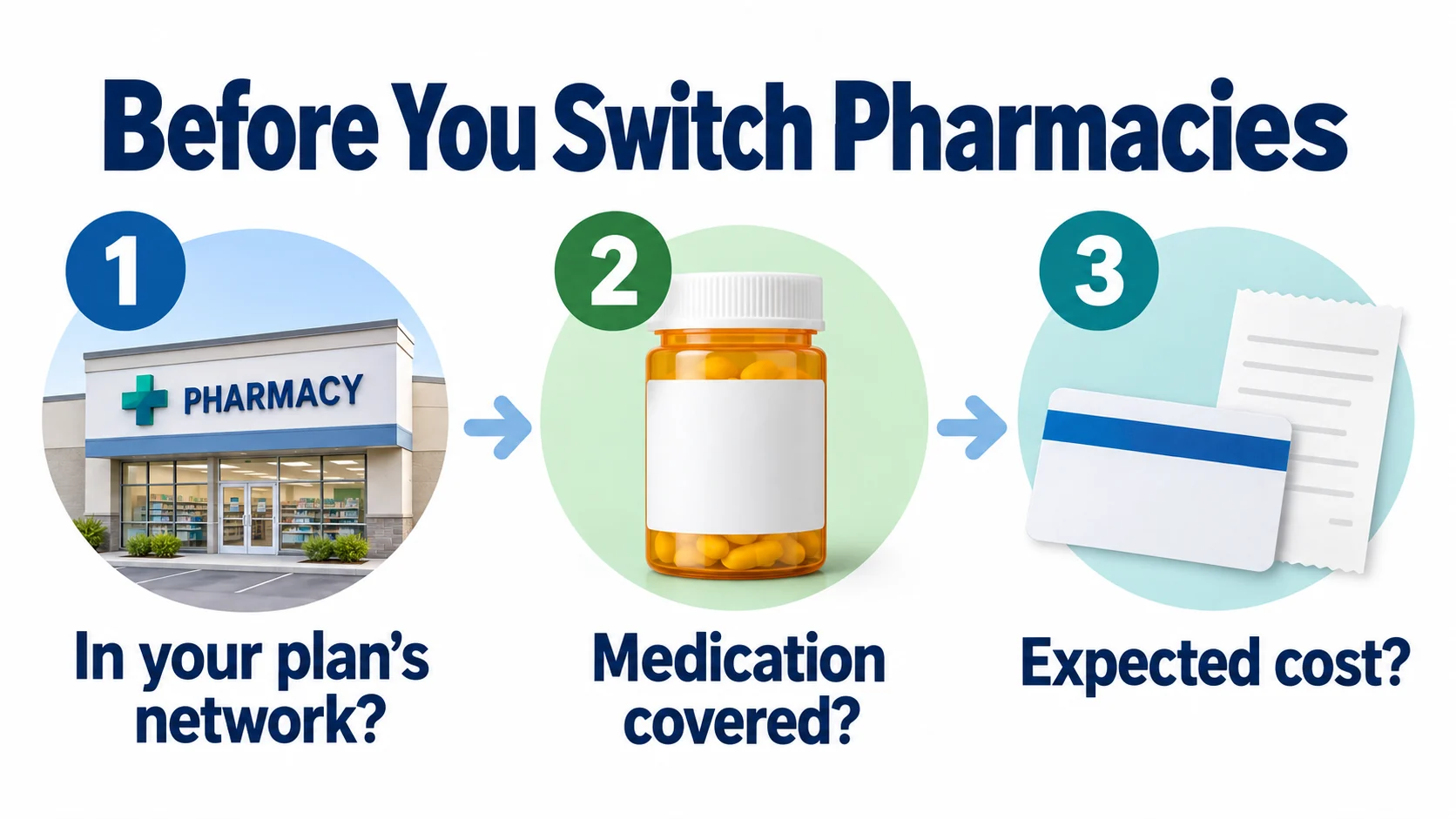
What should I confirm before switching pharmacies?
- Identify your prescription plan. Have your current pharmacy-benefit card or relevant coverage information ready.
- Check the exact location. Ask whether it participates in your particular network and whether preferred pricing applies.
- Review each medication. Confirm the drug, strength, quantity, and supply length.
- Ask about restrictions. Check refill timing, existing approvals, and any required dispensing arrangement.
- Clarify the price and status. Ask what you are expected to pay and whether the prescription is ready.
You can say: “I want to move this prescription to [pharmacy]. Is that location in network for my exact plan, what would my cost be for this quantity, and are there any coverage requirements to resolve?”
What if insurance rejects the prescription at the new pharmacy?
Ask for the specific reason. The next step may involve correcting insurance details, checking the network, reviewing refill timing, or obtaining information from the prescriber. A rejection is not always the same as a final decision that the medicine is never covered.
If the plan will not cover the drug, ask the plan about its exception or appeal process and discuss appropriate treatment options with your prescriber. Approval is not guaranteed.
If you are running low, tell the pharmacist how much remains and when the next dose is due. Ask your pharmacist or prescriber for an individualized plan rather than changing or rationing doses yourself.
ABC Drugs’ prescription insurance and copay assistance page explains the support available for reviewing claim issues. Our prescription transfer service can help coordinate eligible transfers; your insurance plan determines coverage.
Frequently asked questions about insurance when switching pharmacies
Do I need to change insurance to change pharmacies?
Not necessarily. You may be able to use another pharmacy within your existing plan’s network. Verify participation for your specific plan before moving the prescription.
Can an independent pharmacy accept my prescription insurance?
Yes, independent pharmacies can participate in insurance networks. Participation depends on the pharmacy and exact plan, so confirm your coverage rather than relying on whether the pharmacy is independent or part of a chain.
Will my copay be the same at every in-network pharmacy?
Not always. Some plans have preferred and standard network pharmacies with different patient costs. Compare the same medicine, strength, quantity, and days’ supply under your plan.
Does switching pharmacies change my insurance plan’s drug list?
Changing pharmacies alone does not change the plan you are enrolled in or its formulary. However, the new pharmacy still needs to process the prescription under the applicable coverage rules.
Does my prior authorization transfer with my prescription?
The prescription transfer and the insurance approval are separate records. Ask the new pharmacy and your plan whether the existing authorization applies to the medication, quantity, and dispensing arrangement being requested. Additional coordination may be needed.
Can I transfer a prescription before insurance allows the next refill?
A transfer and a covered refill have different requirements. Ask the receiving pharmacy whether the prescription can move now and when the plan will allow the next paid fill. Moving it does not automatically permit an early refill.
Can I switch from mail order to a local pharmacy?
Ask your plan whether retail fills are covered for your medication and supply length. Coordinate any pending mail-order shipment with the dispensing pharmacy before starting another request so everyone knows what has already been processed.
Can I move a specialty medication to any pharmacy?
Do not assume every pharmacy is eligible to dispense it under your benefit. Ask the plan which pharmacies may fill that specific medicine and whether additional requirements apply before requesting the move.
What insurance information should I give the new pharmacy?
Provide your current prescription-benefit card or coverage details, your name and date of birth, and information about any recent insurance change. Share existing approval information if available. Use the pharmacy’s requested secure method.
Will insurance reimburse me if I pay cash while coverage is being checked?
Do not assume reimbursement is available. Ask your plan about its rules before paying when possible. Keep the itemized receipt and ask how to submit a claim if permitted; paying cash does not guarantee repayment or credit toward plan spending limits.
Sources
- Medicare: What Pharmacies Can I Use?
- HealthCare.gov: Getting Prescription Medications
- HealthCare.gov: Glossary of Health Coverage and Medical Terms
- Medicare: Drug Plan Rules
- New York State Department of Health: NYRx Consumer Information
- CVS Caremark: 2026 Provider Manual — Refill Timing and Claims
- CVS Caremark: Prescription Costs and Coverage
- Independence Blue Cross: Prescription Drug FAQs
This article is for general educational and informational purposes only and is not a substitute for personalized medical advice. Talk with your pharmacist or healthcare provider about questions concerning your medications or health conditions.