Direct Answer
Your prescription may be rejected by insurance because of incorrect insurance information, an early refill request, a prior authorization requirement, a medication coverage restriction, or a billing issue.
A rejected insurance claim does not necessarily mean your prescription is invalid or that your medication will never be covered. Your pharmacist can review the rejection message, explain what it indicates, and help you understand whether the next step involves the pharmacy, your prescriber, or your insurance company.
Key Takeaways
- An insurance rejection is not always a final denial of medication coverage.
- Rejections can result from administrative problems, refill timing, or insurance plan requirements.
- Some problems can be corrected by the pharmacy; others require action by your prescriber or insurer.
- Coverage exceptions and appeals may be available, depending on your plan.
- If a delay could interrupt an important medication, contact your pharmacist or healthcare provider promptly.
What Does It Mean When Insurance Rejects a Prescription?
When a pharmacy submits a prescription claim electronically, the insurance plan or its pharmacy benefit administrator evaluates the claim against applicable coverage and billing rules.
If the claim cannot be processed as submitted, the system may return a rejection message. That message helps identify the issue. For example, it may indicate that a refill is too early, additional authorization is required, or the medication is subject to a plan restriction.
The rejection does not necessarily explain the entire situation. Additional information may be needed to determine the appropriate resolution.
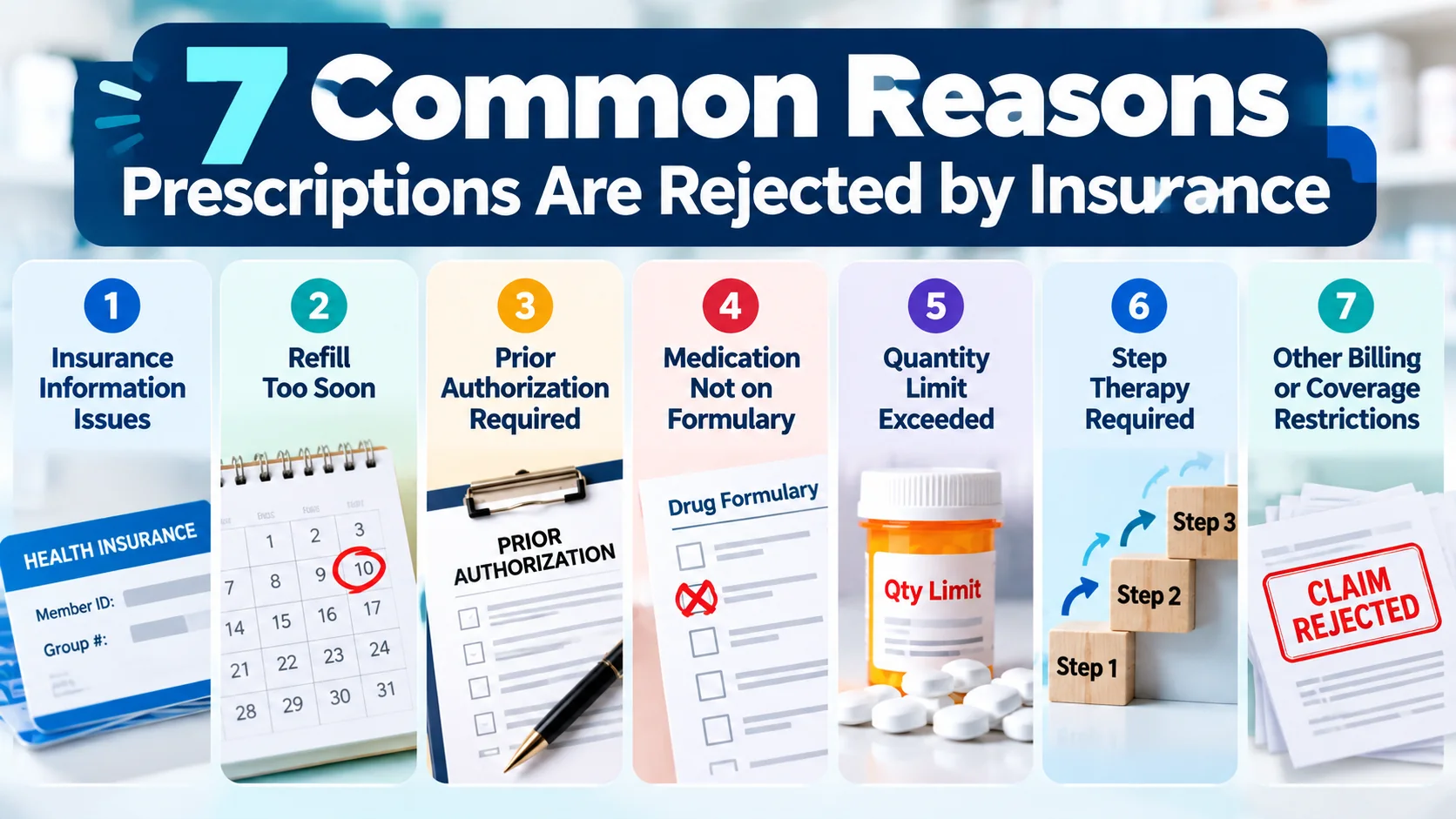
Seven Common Reasons Your Prescription May Be Rejected
1. Incorrect or outdated insurance information
The pharmacy may have an old insurance card, an incorrect member number, or information that does not match the insurer's records.
What to do: Confirm your current insurance details with the pharmacy. If coverage appears inactive or incorrect, contact your insurance company.
2. Your prescription is being refilled too soon
Insurance plans may limit how early they will pay for another supply of medication. For example, the insurer's records may indicate that you should still have medication remaining from a previous fill.
What to do: Ask your pharmacist about the next eligible refill date. If your dose changed, your medication was lost, or you have another unusual circumstance, explain the situation so the pharmacy can identify appropriate options.
Related guide: Prescription Refill vs. Renewal.
3. Your medication requires prior authorization
Some medications require the insurer to review additional clinical information before approving payment. Your prescriber may need to explain why the prescribed medication is appropriate for your medical needs.
What to do: Ask whether prior authorization is required and whether your prescriber's office has received the request. Approval is not guaranteed.
4. Your medication is not on the insurance formulary
A formulary is a list of medications covered by a health plan. A medication that is not on the list may require a coverage exception or another solution determined with your healthcare team.
What to do: Ask your insurer about coverage requirements and discuss any potential alternative with your prescriber. Do not change medications independently.
5. The prescription exceeds a quantity limit
An insurance plan may restrict how much of a medication it covers within a particular period. For example, a plan may cover a certain number of tablets or a specific days' supply.
What to do: Ask your pharmacist whether the rejection concerns quantity or days' supply. Your prescriber may need to review the prescription or request an exception when appropriate.
6. Your plan has a step therapy requirement
Step therapy means the insurer may require certain treatment criteria to be met, sometimes including trying a preferred medication before covering another option. This does not mean the preferred medication is appropriate for every patient.
What to do: Discuss the requirement with your prescriber. Depending on the plan and your clinical circumstances, an exception may be available.
7. Other billing, network, or coverage restrictions
Some rejections involve pharmacy network rules, discrepancies in submitted information, or medication safety checks.
What to do: Ask the pharmacy what the rejection message indicates. The appropriate response may involve correcting claim information, contacting the insurer, or discussing a safety concern with the pharmacist.
Is a Rejected Claim the Same as Denied Coverage?
Not necessarily. A pharmacy claim rejection may be a processing response, while a formal coverage denial may follow a coverage decision under the applicable plan.
| Pharmacy claim rejection | Formal coverage denial |
|---|---|
| May occur when a claim is submitted at the pharmacy. | May result from a formal coverage decision or request. |
| Can involve billing information or plan restrictions. | Concerns whether the insurer will cover the requested medication or benefit. |
| Some issues can be resolved by correcting information. | May involve reconsideration, an exception, or an appeal. |
| Does not always represent a final decision. | May establish formal appeal rights under the applicable plan. |
For Medicare Part D, the Centers for Medicare & Medicaid Services (CMS) describes coverage determinations involving prescription drug benefits, exceptions, cost-sharing, and certain plan restrictions. Specific procedures vary by plan type.
What Should You Do When Your Prescription Is Rejected?
Start by asking your pharmacist what the rejection message says. Then follow the appropriate next step:
- Confirm your insurance information. Make sure the pharmacy has your correct current coverage details.
- Identify the specific problem. Determine whether the issue involves refill timing, prior authorization, formulary coverage, or another restriction.
- Contact the appropriate party. Some issues can be handled by the pharmacy; others require your prescriber or insurer.
- Ask about available options. Depending on your plan, these may include a corrected claim, coverage exception, or appeal.
- Follow up if treatment may be interrupted. Explain when you expect to run out of medication.
Keep a record of relevant communications, including any insurer reference number or instructions provided.
What Can Your Pharmacist Help With?
Your pharmacist may be able to explain the claim rejection, confirm submitted prescription information, identify refill timing restrictions, and help determine whether additional action is required.
At ABC Drugs, patients can ask about Prescription Insurance Assistance when they have questions about prescription coverage or claim processing.
However, a pharmacy cannot guarantee approval of a prior authorization, override every insurance restriction, or make a coverage decision on behalf of an insurer.
If you recently changed pharmacies, our guide to Insurance Coverage When Switching Pharmacies explains additional issues that may arise during a transfer.
What If You Are Running Out of Medication?
If an insurance problem may cause you to miss an important medication, contact your pharmacist and prescriber promptly.
Explain which medication is affected, when your supply will run out, and whether you have already missed any doses.
Depending on the medication, your clinical situation, and applicable plan or legal requirements, the healthcare team may be able to identify an appropriate short-term option.
Do not independently stop treatment, double doses, or change how you take your medication to compensate for an insurance delay.
Seek urgent medical assistance if you develop severe symptoms or believe you are experiencing a medical emergency.
Frequently Asked Questions
1. Does an insurance rejection mean my prescription is invalid?
No. A prescription may be valid even when the insurance claim cannot be processed. The reason for the rejection must be identified.
2. Can my pharmacist fix a rejected prescription claim?
Sometimes. The pharmacy may be able to correct claim information or clarify a processing issue. Other rejections require action by the prescriber or insurer.
3. Why does insurance say my refill is too soon?
The insurer may calculate that you should still have medication remaining from your previous fill. Ask the pharmacist to check the eligible refill date and explain any changed circumstances.
4. What if my medication needs prior authorization?
Your prescriber may need to provide clinical information to the insurance plan. The insurer determines whether its coverage requirements are satisfied.
5. Can insurance reject a medication my doctor prescribed?
Yes. A valid prescription does not automatically establish insurance coverage. Plans may apply formularies and other coverage requirements.
6. What if my insurance does not cover the medication?
Ask about your plan's coverage rules and whether an exception or appeal is available. Your prescriber can help evaluate clinically appropriate options.
7. Can I pay cash if insurance rejects my prescription?
In some circumstances, yes, but payment and dispensing options depend on the medication, applicable rules, and your situation. Ask the pharmacy about the implications before deciding.
8. Will changing pharmacies solve the rejection?
Not necessarily. Some rejections are tied to the insurance plan or medication rather than the pharmacy. Network-related issues may be different.
9. How long does it take to resolve an insurance rejection?
It varies. Simple information corrections may be resolved quickly, while prior authorizations or formal coverage reviews can take longer.
10. What should I do if I cannot wait for the insurance issue to be resolved?
Contact your pharmacist and prescriber promptly, explain when your medication will run out, and ask about medically appropriate options. Do not change your treatment on your own.