Reviewed by: Alice, PharmD — Supervising Pharmacist Last medically reviewed: October 15, 2026
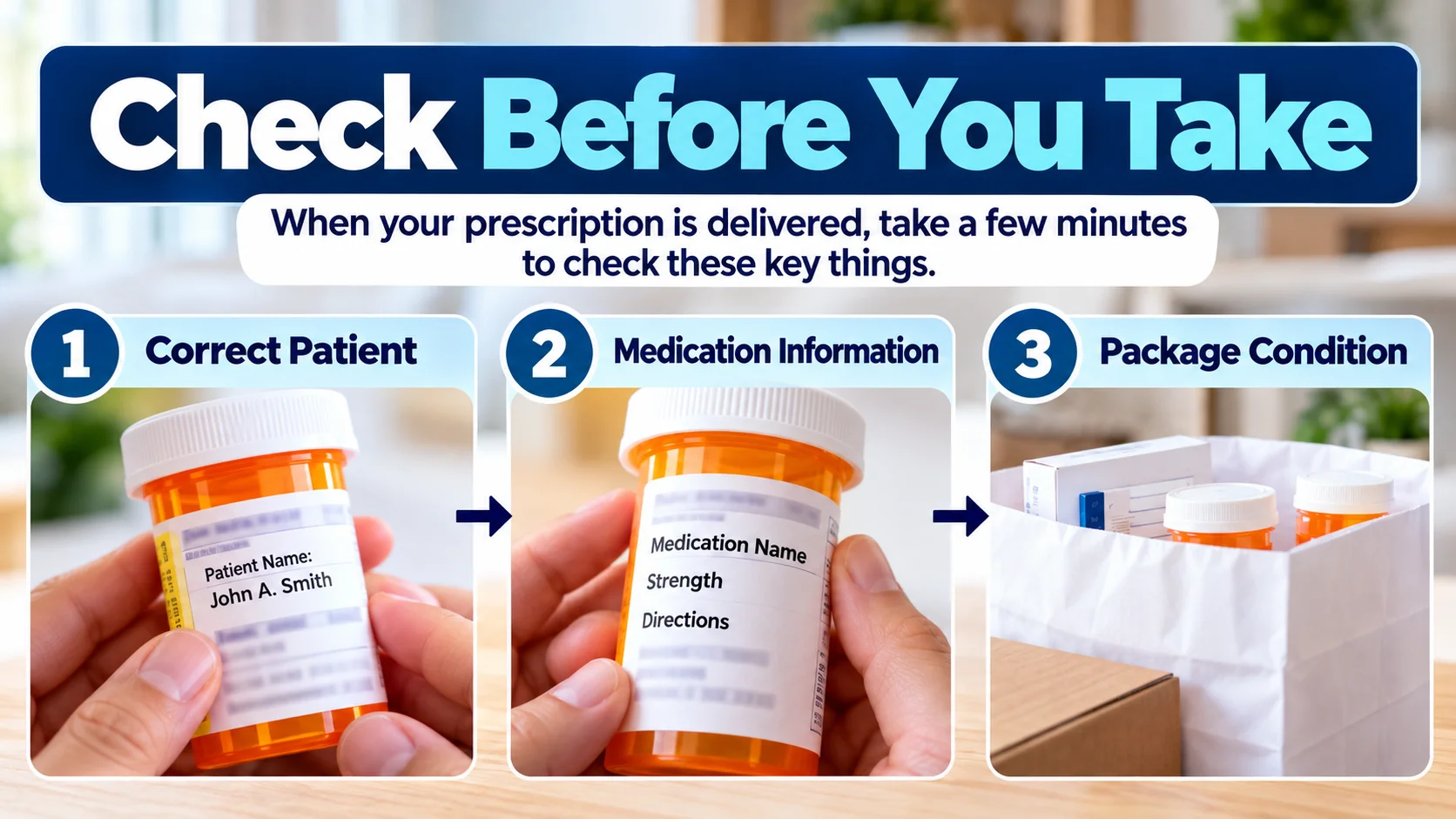
When a prescription arrives at your home, take a few moments to check it before using the medication. Confirm that the prescription is for you, review the medication name and directions, and look for any problems with the package or its contents.
These checks are useful whether you receive medication yourself or a family member or caregiver accepts the delivery for you.
A prescription delivery should provide the same opportunity to identify a possible mistake or ask a pharmacist a question as picking up medication in person. MedlinePlus recommends checking the label and medication when receiving a prescription.
Key Takeaways
- Check that the prescription label shows the correct patient.
- Confirm the medication name, strength, and directions.
- If the medication looks different from what you expected, ask the pharmacist before taking it.
- Look for damaged packaging and follow medication-specific storage instructions.
- If something appears incorrect, do not guess or take the medication in question until the concern has been resolved.
1. Check That the Prescription Is for the Correct Patient
Start with the patient's name on the prescription label.
This is especially important when several people in one household receive medications, or when a caregiver accepts a delivery for someone else.
If the package contains prescriptions for more than one person, check each label individually. Do not assume that every medication in the bag belongs to you.
If the patient name is incorrect or you receive a prescription that appears to belong to someone else, contact the pharmacy before using it.
2. Review the Medication Name, Strength, and Directions
Next, read the prescription label.
Look for the medication name, strength, and instructions for use. If you expected a particular medication or a recent dose change, make sure the information matches what your healthcare provider told you.
For example, if your prescriber recently changed your directions, do not assume the new prescription reflects that change without checking.
MedlinePlus recommends reviewing the label, including the patient's name, medication, dose, and how often the medication should be taken.
For a more detailed explanation, read ABC Drugs' guide to reading a prescription label .
3. Look at the Medication Itself
Sometimes a medication looks different from the one you received previously.
Tablets or capsules may have a different color, shape, or marking because the pharmacy dispensed an equivalent product from a different manufacturer. But a change in appearance should not automatically be assumed to be harmless.
If you notice an unexpected difference, ask the pharmacist to confirm that you received the intended medication.
Do not identify medication based on color alone.
If the pharmacy supplied a liquid, inhaler, cream, or another dosage form, review the packaging and directions appropriate to that product.
4. Check the Package for Damage
Look at the delivery bag and the medication's packaging.
If a bottle appears broken, a container is leaking, or the packaging is visibly damaged, contact the pharmacy.
Do not use medication that may have been contaminated or damaged until the pharmacist has evaluated the concern.
A delivery bag that looks slightly wrinkled is not necessarily a medication-safety problem. What matters is whether the condition of the packaging raises a concern about the medicine itself.
If you are uncertain, ask.
5. Follow Storage Instructions Promptly
Some medications need protection from heat, moisture, or light. Others have specific refrigeration requirements.
When a delivery arrives, review any storage instructions and put the medication in the appropriate location.
Do not assume every prescription belongs in the refrigerator, and do not assume every medication can safely remain at room temperature.
If a medication that requires special handling appears to have been exposed to unsuitable conditions, contact the pharmacist for product-specific guidance before using it.
6. Check That You Received What You Were Expecting
If you were expecting several prescriptions, check which ones actually arrived.
A pharmacy may deliver only prescriptions that are ready and eligible at that time. Another prescription could still be awaiting a refill authorization, insurance resolution, or medication availability.
If an expected prescription is missing, contact the pharmacy to ask about its status.
For patients managing several medications, ABC Drugs also has a guide to keeping track of multiple medications .
A current medication list can make it easier to recognize which prescriptions you expected to receive.
7. What Should You Do If Something Seems Wrong?
If the patient name, medication information, appearance, or package condition raises a concern, contact the pharmacy before taking the medication in question.
Explain what you noticed. The pharmacist may ask you to read information from the label or describe the medication and packaging.
Do not change the medication, substitute another person's prescription, or try to correct an apparent dispensing issue yourself.
If you have already taken a medication you suspect was incorrect, seek prompt professional advice. If you experience severe symptoms, such as trouble breathing, seek emergency medical care.
8. Questions Worth Asking Your Pharmacist
Receiving a prescription at home should not prevent you from getting medication counseling.
You can ask:
- Is this the medication and strength my prescriber intended?
- Why does this tablet or capsule look different?
- Are these the most recent directions?
- Does this medication have special storage requirements?
- What should I do if I think the package was damaged?
- Is there anything important I should know before starting this medication?
ABC Drugs offers pharmacist consultation for medication-related questions.
Receiving Prescription Deliveries Through ABC Drugs
ABC Drugs offers free same-day local prescription delivery for eligible prescriptions in East Harlem, Harlem, and nearby Upper Manhattan neighborhoods.
If you receive a delivery and have a question about the medication, label, or packaging, contact the pharmacy for guidance.
For delivery availability, eligibility, and service details, visit the ABC Drugs Free Same-Day Prescription Delivery service page.
If you are preparing for your first delivery, see what to know before getting prescriptions delivered.
Frequently Asked Questions
1. What is the first thing I should check when my prescription arrives?
Check the patient name on the prescription label. Then review the medication name, strength, and directions before using it.
2. What if the prescription label has the wrong name?
Do not use the medication. Contact the pharmacy promptly and explain the discrepancy.
3. Why does my medication look different from my previous refill?
A different manufacturer or equivalent generic product may explain the change. However, ask the pharmacist to confirm the medication before taking it.
4. Should I check every bottle if several prescriptions arrive together?
Yes. Check each prescription separately, especially when the delivery includes medications for multiple household members.
5. What should I do if a medication bottle is damaged or leaking?
Contact the pharmacy before using the medication. The pharmacist can assess the concern and explain the next steps.
6. What if a prescription I expected is missing from the delivery?
Contact the pharmacy to ask whether it is still being processed, awaiting authorization, or scheduled separately.
7. Can I use medication if the delivery bag looks damaged?
The condition of the outer bag does not necessarily establish that the medication is damaged. If the medication container or product may have been affected, ask the pharmacist before using it.
8. What if my medication was supposed to be refrigerated?
Follow the product-specific storage instructions promptly. If you are concerned about temperature exposure during delivery, contact the pharmacist before using it.
9. Can I ask the pharmacist about medication directions after delivery?
Yes. Contact the pharmacy if directions are unclear or you have questions about how to take or store your medication.
10. What if I already took medication that I think may be incorrect?
Seek prompt professional advice from your pharmacist, healthcare provider, or Poison Control at 1-800-222-1222 in the United States. For severe symptoms or an emergency, call 911.
Sources & References
- MedlinePlus — Medicine Safety: Filling Your Prescription. Primary evidence for checking labels, medication appearance, and directions when receiving a prescription.
- ABC Drugs — Pharmacy FAQs. ABC Drugs delivery-process and medication-handling information.
- ABC Drugs — Pharmacist Consultation. ABC Drugs medication counseling service.
Medical Disclaimer This article is for general educational and informational purposes only and is not a substitute for personalized medical advice. Talk with your pharmacist or healthcare provider about questions concerning your medications or health conditions.