You pick up an injectable prescription, put it in your refrigerator, and later wonder: can it travel in a bag, how long can it stay out, and what if it becomes warm? These are important questions because storage instructions can differ even between products containing the same active ingredient.
How Should You Store Weight-Loss Injections and GLP-1 Medications?
Start with the medication's dispensing label, package insert, and instructions for use. Many injectable products are refrigerated before use. However, a pen intended for several doses may have different instructions from a single-dose pen or syringe. A brand may also offer more than one device.
Where in the refrigerator should the medicine go?
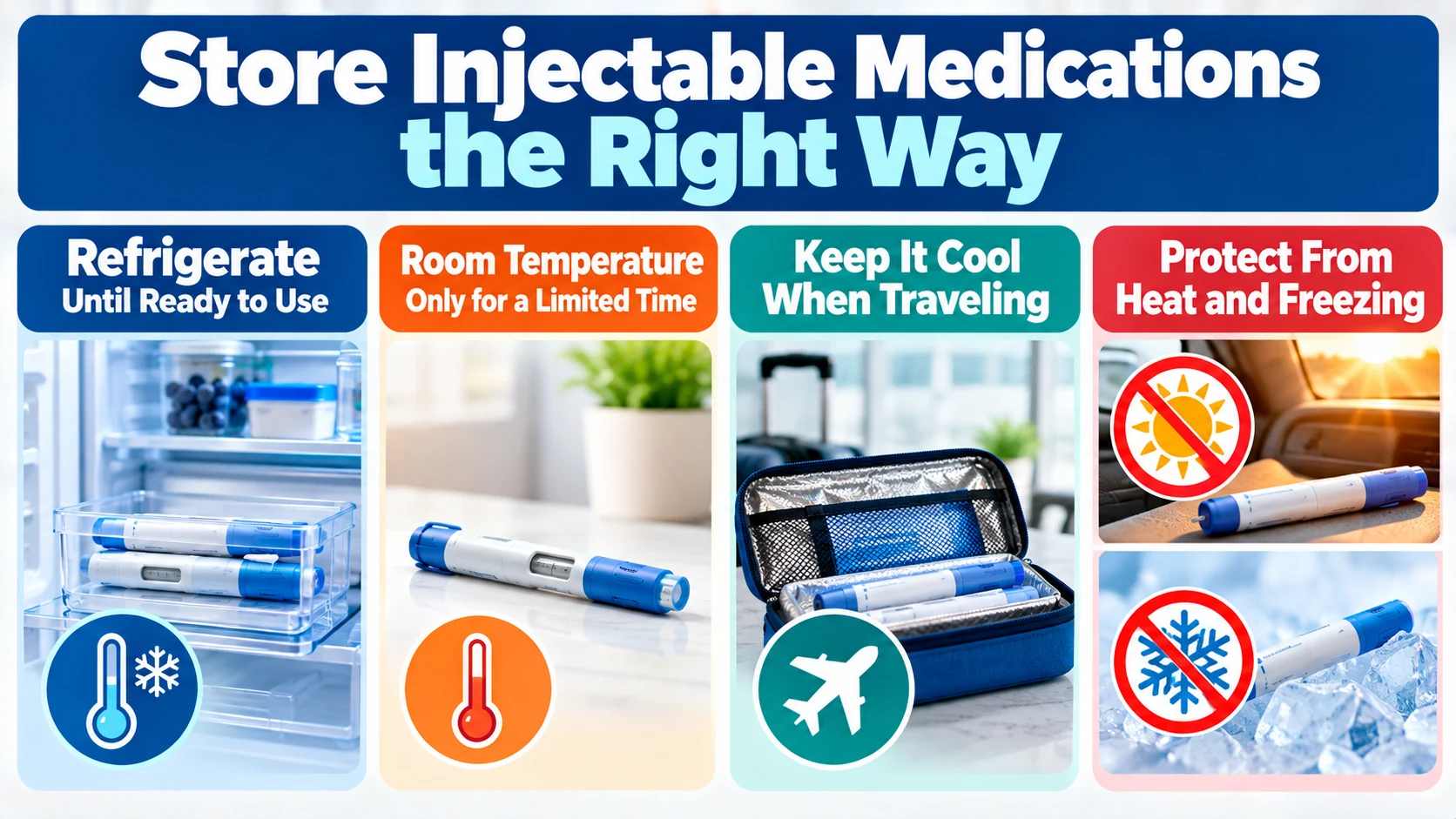
Follow the labeled temperature range. Avoid the freezer and direct contact with the refrigerator's cooling element. Keep medication in its original carton when required for protection from light. A refrigerator door or area prone to temperature changes may be less reliable than a consistently cool interior shelf.
Does every injection have the same room-temperature limit?
No. Some products permit a limited period outside the refrigerator before use; others have separate limits after first use. These periods are not interchangeable. The specific product instructions—not the general term “semaglutide” or “tirzepatide”—determine the answer.
How Should Wegovy, Ozempic, and Mounjaro Be Stored?
The following examples summarize selected U.S. FDA-labeled presentations, not every device or package sold under these names. Confirm which presentation you have and read its current instructions. The limits below are not permission to use medicine after its expiration date.
| Specific presentation | Refrigerated storage | Limited room-temperature storage |
|---|---|---|
| Wegovy single-dose injection pen or syringe | 36°F–46°F (2°C–8°C) | Before cap removal, up to 28 days at 46°F–86°F (8°C–30°C), in original carton |
| Ozempic multi-dose pen | Before first use: 36°F–46°F (2°C–8°C) | After first use: up to 56 days at 59°F–86°F (15°C–30°C), or refrigerated |
| Mounjaro single-dose pen or vial | 36°F–46°F (2°C–8°C) | Up to a total of 21 days at no more than 86°F (30°C) |
Important: Current U.S. labeling also describes other presentations, including Wegovy FlexTouch, Ozempic single-dose syringes, and Mounjaro multi-dose vials or KwikPens, with different rules. Do not apply the table's timeframe to those devices. See the linked official labeling in the references.
Wegovy and Ozempic both contain semaglutide, but their labeled devices and storage periods can differ. Mounjaro contains tirzepatide and has its own device-specific rules. This is why asking “how long does semaglutide last out of the fridge?” without identifying the product may lead to an incorrect answer.
Do Storage Rules Change After Opening or First Use?
They can. A single-dose pen is generally discarded after its one use; it is not kept for future doses. A multi-dose pen may have a defined in-use period that starts with the first administration, even when some medication remains.
For example, the FDA labeling for an Ozempic multi-dose pen specifies a 56-day in-use period. The current Wegovy labeling includes a different 56-day in-use provision for its FlexTouch multi-dose presentation, while the Wegovy single-dose device follows a separate pre-use rule. Check the device name and never transfer a timeframe from one presentation to another.
Also check the printed expiration date. The applicable discard date may be earlier because of time outside refrigeration or time since first use.
What Happens If an Injection Is Left Unrefrigerated, Frozen, or Overheated?
There is no reliable way to judge medication quality by appearance alone. Storage outside the approved conditions can affect quality, and the appropriate next step depends on the exact product, how warm or cold it became, and how long the exposure lasted.
- Do not use the affected dose yet. Keep the packaging and label available.
- Identify the exact product and device. Note whether it was unopened or already in use.
- Record what happened. Estimate the temperature, duration, and whether the medication froze or was exposed to direct sunlight.
- Ask your pharmacist or manufacturer. Follow their product-specific guidance on whether it must be discarded.
- Arrange the next step. If replacement is necessary, ask about prescription processing and timing rather than changing your schedule yourself.
If you need help with an unavailable replacement, our guide on weight-management prescription delays and out-of-stock medications explains possible next steps. If a replacement raises coverage questions, see insurance coverage for weight-management medications.
How Can You Protect Injectable Medication During Travel or Delivery?
Plan around the temperature limits on your actual package. Ask the pharmacist whether your trip fits the permitted room-temperature period or requires temperature-controlled transport. Protect the medicine from direct sunlight, parked cars, freezing conditions, and contact with ice or frozen packs. Do not assume an ordinary insulated bag maintains the correct temperature for an entire journey.
When receiving a shipment, promptly check the package and any temperature-handling instructions. If a medicine that requires refrigeration arrives warm or appears inadequately cooled, do not use it until the dispensing pharmacy or manufacturer confirms what to do. The FDA has specifically warned about quality concerns involving improperly shipped injectable GLP-1 products.
How Long Does Compounded Semaglutide Last in the Refrigerator?
There is no universal refrigerated shelf life for compounded semaglutide. Compounded preparations are not FDA-approved products, and their formulation, container, handling instructions, and assigned beyond-use date may differ. Do not borrow an expiration date or 28-, 56-, or 21-day room-temperature limit from a branded product.
Read the dispensing pharmacy's label for the required storage range, beyond-use date, and directions after first puncture. Contact that pharmacy if the label is unclear or the vial was shipped warm. The FDA advises against using injectable GLP-1 products that arrive warm or without adequate refrigeration and provides additional guidance for multi-dose compounded vials.
If a compounded vial has been punctured, follow the dispensing pharmacy's directions and applicable FDA safety guidance; do not assume that an unopened-vial date also applies after first use. Ask the pharmacist about sterile handling and the appropriate discard date.
When Should You Ask Your Pharmacist About Storage?
Contact your pharmacist when you are unsure which device you have, cannot read the storage directions, plan to travel, experience a power outage, receive a warm shipment, or find a pen outside the refrigerator unexpectedly. Bring the product carton or a photo of its label and explain the temperature exposure as accurately as possible.
For a broader medication discussion, see five questions to ask your pharmacist about weight-management medications. Storage counseling is one part of using a prescription safely; your pharmacist can also help clarify handling and device instructions.
Frequently Asked Questions
1. How do you store weight-loss injections at home?
Check the exact product and device. Many unopened injections require refrigeration at 36°F–46°F (2°C–8°C), protection from freezing, and storage in the original carton. Confirm any allowed room-temperature period on the label.
2. How should semaglutide injections be stored?
It depends on whether the product is Wegovy, Ozempic, or a compounded preparation, and on the device. Semaglutide is an ingredient, not a single storage schedule. Follow the instructions for your dispensed product.
3. How long can a Wegovy single-dose pen stay at room temperature?
Current U.S. labeling permits a Wegovy single-dose pen or syringe to remain at 46°F–86°F (8°C–30°C) for up to 28 days before cap removal, with the product protected in its original carton. Other Wegovy presentations can differ.
4. How long can an Ozempic pen be left unrefrigerated?
For the multi-dose Ozempic pen, after first use the FDA label allows storage for up to 56 days at 59°F–86°F (15°C–30°C), or refrigerated. An unused multi-dose pen should be refrigerated before first use. Ozempic single-dose syringes have different rules.
5. How should Mounjaro be stored?
Mounjaro single-dose pens and vials are refrigerated at 36°F–46°F (2°C–8°C), with up to a total of 21 days at room temperature no higher than 86°F (30°C) when needed. Mounjaro multi-dose devices have different limits; identify the exact presentation first.
6. How long does tirzepatide last in the fridge?
For an unopened FDA-approved product kept within its labeled refrigerated conditions, check the printed expiration date. The answer also depends on the brand and presentation. Do not treat a compounded tirzepatide preparation as having the same shelf life.
7. What if I already injected semaglutide that may have been stored incorrectly?
Do not take an extra or replacement dose on your own. Contact your pharmacist or prescribing clinician promptly with the exact product and exposure details; seek urgent medical attention for severe symptoms. They can advise on the next steps.
8. Can I put an injection back in the refrigerator after traveling?
Whether refrigeration can resume, and how the allowable time is counted, depends on the product and device. Do not assume returning it to the refrigerator resets a labeled room-temperature limit. Check the official instructions or ask your pharmacist.
9. How long does unopened compounded semaglutide last in the fridge?
There is no single approved duration. Follow the specific beyond-use date and refrigeration instructions supplied by the compounding pharmacy, and contact that pharmacy if the shipment was warm or the labeling is unclear.
10. Can I use an injection if it accidentally froze?
Do not use Wegovy, Ozempic, or Mounjaro products that have frozen; their FDA labeling warns against use after freezing. Contact your pharmacist about safe disposal and replacement.
Questions About Your Weight-Management Prescription?
ABC Drugs serves patients in Harlem, New York City. Our pharmacy team can help explain product-specific storage directions, handling questions, and prescription-related concerns. Learn about ABC Drugs Weight-Management Prescription Support or ask about pharmacist consultation. Storage advice does not replace evaluation by your prescribing clinician.
Sources & References
- DailyMed: Wegovy — current U.S. prescribing information, storage by device.
- DailyMed: Ozempic — U.S. prescribing information and instructions for use.
- DailyMed: Mounjaro — U.S. prescribing information and device-specific storage.
- Novo Nordisk Medical: GLP-1 receptor agonist storage and stability.
- U.S. FDA: Concerns with unapproved GLP-1 drugs used for weight loss.
Product labeling can change. Check the current U.S. instructions for the exact medication and device before relying on a temperature or time limit.