Your prescriber has recommended a weight-management medication, but you are unsure whether your health plan will pay for it. Insurance rules can be confusing—especially when the same medicine may have different approved uses and different coverage rules.
Why Doesn't My Insurance Cover a Weight-Management Prescription?
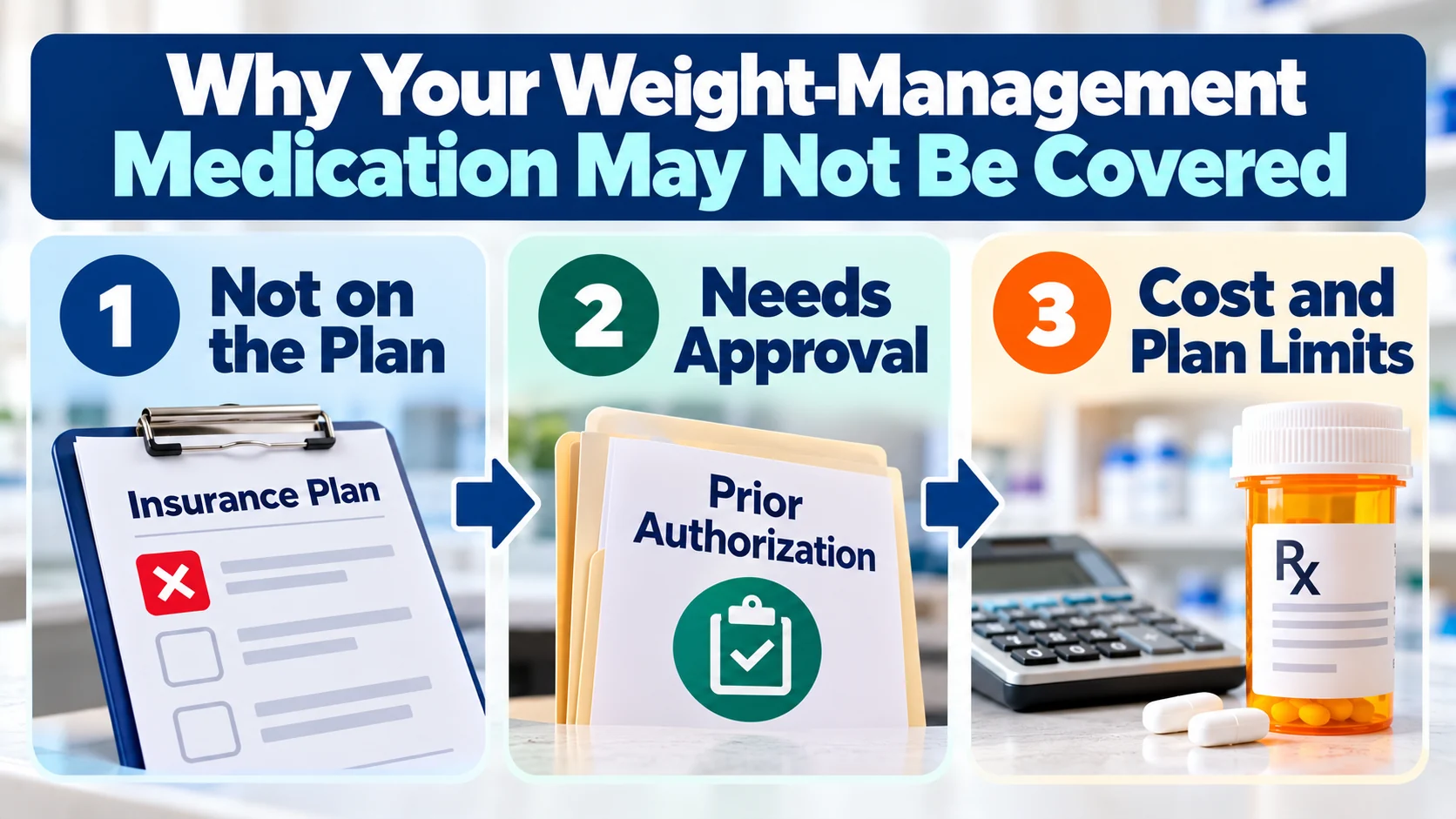
Health plans set their own covered-drug lists, called formularies, and may apply different rules depending on the medication and the reason it is prescribed. A drug may be excluded for weight management, covered only for certain indications, or covered after additional review. Your employer's benefit design and the type of health plan can also matter.
Common reasons for a coverage problem
- Plan exclusion: The benefit may not cover medications prescribed specifically for weight management.
- Nonformulary medication: The prescribed product may not be on the plan's preferred drug list.
- Prior authorization: The insurer may require clinical information before deciding whether to pay.
- Step therapy or other restrictions: Some plans require specific criteria, documentation, or previous treatment steps.
- Quantity or refill limits: The plan may restrict how much it will cover or how frequently it can be dispensed.
A pharmacy's claim message may identify the immediate issue, but the insurer is the appropriate source for the plan's complete coverage criteria.
Which Weight-Management Medications Are Usually Covered by Insurance?
There is no single medication that is covered by every insurance plan. Coverage can differ even between two plans offered by the same insurance company. The correct comparison is between the specific prescribed medication and your specific plan's formulary and benefit rules.
It also matters whether a product is FDA-approved for chronic weight management or for another condition. For example, Ozempic has FDA-approved indications related to type 2 diabetes and certain associated risks; it is not itself FDA-approved as a chronic weight-management drug. A plan's coverage rules for Ozempic should not be assumed to match its rules for a medication approved for weight management.
Ask your insurer whether the exact brand, strength, and prescribed indication are covered and whether prior authorization or a preferred alternative applies. Only your prescribing clinician should determine whether an alternative is medically appropriate.
How Can I Get My Insurance to Cover a Weight-Management Medication?
You cannot guarantee approval, but you can clarify the requirements and avoid unnecessary delays.
- Confirm the exact drug and benefit. Ask the insurer whether your plan covers the prescribed product for the prescribed indication.
- Ask about restrictions. Check for prior authorization, step therapy, quantity limits, and network-pharmacy requirements.
- Find out who must submit paperwork. Prior authorization commonly requires clinical records or justification from your prescriber, not the pharmacy alone.
- Follow up on the decision. If the insurer denies coverage, request the written reason and ask about any available appeal or exception process.
- Coordinate the next step. Your pharmacist can help interpret the pharmacy claim response; your prescriber can address clinical documentation or possible treatment alternatives.
How Much Will a Weight-Management Prescription Cost With or Without Insurance?
Your actual cost may depend on your deductible, copay or coinsurance, pharmacy network, prescription quantity, and whether the plan approves the claim. Without coverage, retail prices can vary by product, pharmacy, and available lawful discounts. A quoted price should always specify the exact product and quantity.
Can Ozempic cost $25 a month with insurance?
Some manufacturer savings programs advertise reduced eligible out-of-pocket costs, but these offers have specific terms, eligibility requirements, exclusions, and limits. A widely advertised dollar amount is not a guaranteed price. Check the manufacturer's current official program terms and your insurance benefits; government-insured patients may be excluded from certain manufacturer copay offers.
Does a 90-day supply cost less?
Not necessarily. Some plans have different copays or dispensing limits for longer supplies, while others do not permit a 90-day fill of a particular product. Ask the plan and pharmacy about the exact prescription and benefit before assuming a lower price.
Be cautious of websites offering prescription medicines without a valid prescription or promising unusually low prices without clear licensing and sourcing information.
What Can a Retail Pharmacist Do When Insurance Rejects the Prescription?
A retail pharmacy can submit a claim, review the insurer's response, identify whether the problem appears to involve coverage, quantity, refill timing, or another claim requirement, and explain which party may need to act next. The pharmacy may also coordinate with the prescriber's office when clarification is needed.
A pharmacy cannot promise that an insurer will approve a medication, override every benefit exclusion, or independently change the treatment selected by your prescriber. If you receive a formal denial, ask your insurer about the reason and its appeals process.
Frequently Asked Questions
How do I get my insurance to cover weight-loss medication?
Check whether your plan covers the exact prescribed product and indication, ask about prior authorization, and have your prescriber provide required clinical information. If coverage is denied, ask the insurer about exceptions or appeals. Approval is not guaranteed.
Which weight-loss drug is usually covered by insurance?
There is no universally covered drug. Formularies and benefit exclusions differ across plans, so check your plan's current coverage rules for the exact medication.
Why does my insurance exclude weight-management medication?
Some plans exclude weight-management drugs as a benefit category, while others cover selected products only when clinical and administrative requirements are met. Ask your insurer for the specific reason.
What is prior authorization for a weight-management prescription?
It is an insurer review that may require the prescriber to submit clinical information before the plan decides whether to cover the medication.
Does an insurance claim rejection mean my prescription was denied permanently?
No. A claim can reject because of missing authorization, refill timing, incorrect billing information, or other issues. Ask the pharmacy for the rejection reason and the insurer for any formal coverage determination.
Can I get Ozempic for $25 a month with insurance?
Not everyone qualifies for advertised savings amounts. Eligibility, plan type, offer limits, and current manufacturer terms matter. Ask your pharmacy to check your actual claim and consult the manufacturer's official savings terms.
How much does a three-month supply of Ozempic cost?
There is no reliable universal price. Cost depends on insurance benefits, product quantity, pharmacy pricing, and eligibility for any applicable program. Request a quote for the exact prescription.
Can my pharmacist submit prior authorization for me?
The pharmacy can identify that authorization is required and may help coordinate communications, but the prescribing clinician generally must provide the clinical information the insurer requests.
Can I appeal an insurance denial?
Many plans provide an appeal or exception process. Ask the insurer for its written denial reason, instructions, deadlines, and the information your prescriber may need to supply.
Will insurance approval mean the medication is in stock?
No. Coverage approval and pharmacy inventory are separate. Ask the pharmacy about actual availability and any dispensing steps still pending.
Questions About Weight-Management Prescription Coverage in Harlem?
ABC Drugs, located at 2095 Madison Ave, New York, NY 10037, can help patients understand pharmacy claim responses and coordinate prescription-related questions with their prescribers. Coverage, prices, and medication availability are not guaranteed.
Learn more about our Weight-Management Prescription Support or call (212) 491-2501.
Sources & References
- HealthCare.gov — Prescription Drug Coverage (formularies and prescription benefits).
- HealthCare.gov — Appealing a Health Plan Decision (appeals and coverage decisions).
- Medicare.gov — Prescription Drugs (Outpatient) (plan-specific prescription coverage information).
- FDA — Ozempic Prescribing Information (approved indications; check current labeling before publication).
- NovoCare — Ozempic Savings Offer (official program terms; verify current offer before quoting amounts).