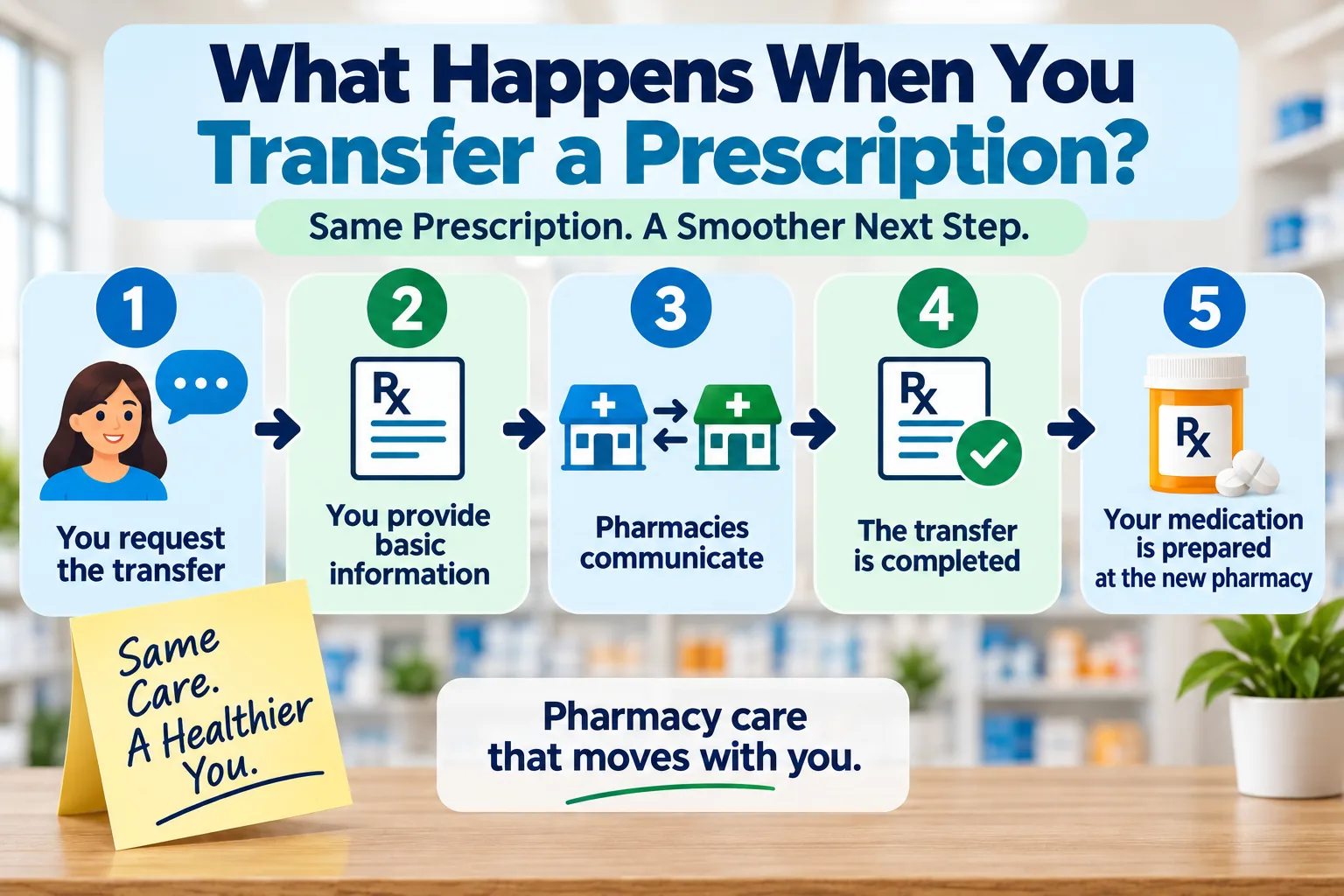
When you transfer a prescription, the new pharmacy receives the existing prescription information from the pharmacy currently holding it so an eligible prescription can be filled at the new location.
In New York, you or your authorized representative must request and approve the transfer. Authorized pharmacy professionals exchange and record the information. For non-controlled prescriptions, the original prescription is invalidated at the transferring pharmacy once the transfer is completed.
Transferring the record and having medicine ready for pickup are separate steps. Requirements vary, particularly for controlled-substance prescriptions.
Key Takeaways
- Start with the pharmacy where you want the eligible prescription filled.
- Have your current pharmacy and prescription information available.
- New York non-controlled prescriptions transfer in full, with remaining authorized refills.
- A completed transfer does not guarantee immediate dispensing.
- Ask about timing before you run out of medicine.
What Does It Mean to Transfer a Prescription?
A transfer moves an eligible existing prescription between pharmacies. It differs from having your prescriber send a new prescription to another pharmacy.
For non-controlled medicines in New York, transfer information may be communicated orally, in writing, or electronically between authorized pharmacy professionals after the patient’s express request and approval.
What Information Do You Usually Need to Provide?
Keep your prescription bottle or label nearby. The receiving pharmacy may ask for:
- Your name, date of birth, and contact information.
- The medication name and strength.
- The prescription number, if available.
- Your current pharmacy’s name and phone number.
Requested details can vary. If you need help finding the Rx number or refill information, see how to read a prescription label.
What Does the New Pharmacy Do After You Request the Transfer?
The receiving pharmacy contacts the pharmacy holding the prescription to obtain the information needed for the transfer.
New York requires non-controlled prescription transfer information to be communicated between licensed pharmacists or by a pharmacy intern under a licensed pharmacist’s direct supervision.
The receiving pharmacist maintains a complete transfer record, including identifying details about the prescription, pharmacies, pharmacy professionals, and relevant dates. Much of this work happens without the patient needing to relay the prescription record personally.
What Happens at Your Current Pharmacy?
For a transferred non-controlled prescription in New York, the transferring pharmacist invalidates the original prescription on file as of the transfer date and documents the transfer.
The receiving pharmacy keeps the transferred prescription record. This is not simply making another active copy for use at both pharmacies.
What Happens to Your Remaining Refills?
In New York, a non-controlled prescription must transfer in full, including all remaining authorized refills.
Current NYSED guidance identifies October 7, 2025 as the effective date of this change. The previous one-refill-at-a-time approach no longer applies to these transfers.
Controlled-substance requirements are different and need prescription-specific assessment.
What if You Do Not Have Any Refills Left?
If further prescriber authorization is needed, moving prescription information alone does not supply it. A renewal or new prescription may be necessary, depending on the circumstances.
Ask the receiving pharmacy what is needed. The prescriber determines whether to issue a new prescription.
How Long Does a Prescription Transfer Take?
There is no single time that applies to every transfer. Communication between pharmacies, opening hours, prescription status, missing information, or prescriber involvement can affect progress.
A transfer being completed does not necessarily mean your medicine is ready. The new pharmacy still needs to complete prescription processing and applicable dispensing requirements.
Ask which step is pending and when to expect an update. Follow the pharmacy’s readiness notification rather than assuming the transfer request itself confirms pickup.
Can Every Prescription Be Transferred the Same Way?
No. Whether and how a prescription can transfer depends on the medicine and applicable requirements.
NYSED states that, effective April 14, 2026, New York permits controlled-substance prescription transfers subject to Article 33 of the Public Health Law and Part 80 of Title 10 of the NYCRR. Applicable federal requirements must also be met.
That is not permission to transfer every controlled prescription in every situation. Ask the pharmacist to assess your specific prescription.
What Can You Do Before Requesting a Transfer?
- Have the current prescription label available.
- Confirm which pharmacy currently holds the prescription.
- Identify the prescriptions you want assessed for transfer.
- Start before your supply runs out and explain if you are running low.
- Ask how the pharmacy will notify you when medicine is ready.
If you are unsure whether a prescription is eligible, ask the receiving pharmacist rather than assuming every medicine follows the same process.
Transferring a Prescription to ABC Drugs
ABC Drugs can help coordinate eligible transfers. To begin the conversation, provide your name, date of birth, and current pharmacy’s name; the team will explain any additional information needed.
See ABC Drugs’ Prescription Transfer service for the available ways to get started.
Frequently Asked Questions
Do I need to call my old pharmacy myself?
Often, you can start with the receiving pharmacy, which coordinates with your current pharmacy. Follow its instructions for your request.
Do I need my prescriber to send a new prescription?
Not for every eligible transfer. A new prescription or other authorization may be needed if no refills remain or the circumstances require it.
Can I transfer more than one prescription?
Potentially. The pharmacy assesses each prescription separately for eligibility and applicable requirements.
Is my medication ready as soon as the transfer is completed?
Not necessarily. Transferring the record and preparing the medicine for dispensing are separate steps. Confirm readiness with the receiving pharmacy.
Sources & References
This article uses New York pharmacy guidance and regulations to explain prescription transfers. Individual eligibility depends on the prescription and applicable requirements.
- New York State Education Department — Prescription RefillsPatient authorization, authorized pharmacy professionals, communication methods, remaining refills, and current transfer-rule effective dates.
- New York State Education Department — Transfer of PrescriptionsTransfer documentation, invalidation of the original non-controlled prescription, and receiving-pharmacy responsibilities.
- New York State Education Department — Transferring Prescriptions for Controlled SubstancesNew York’s April 14, 2026 change, subject to controlled-substance requirements.