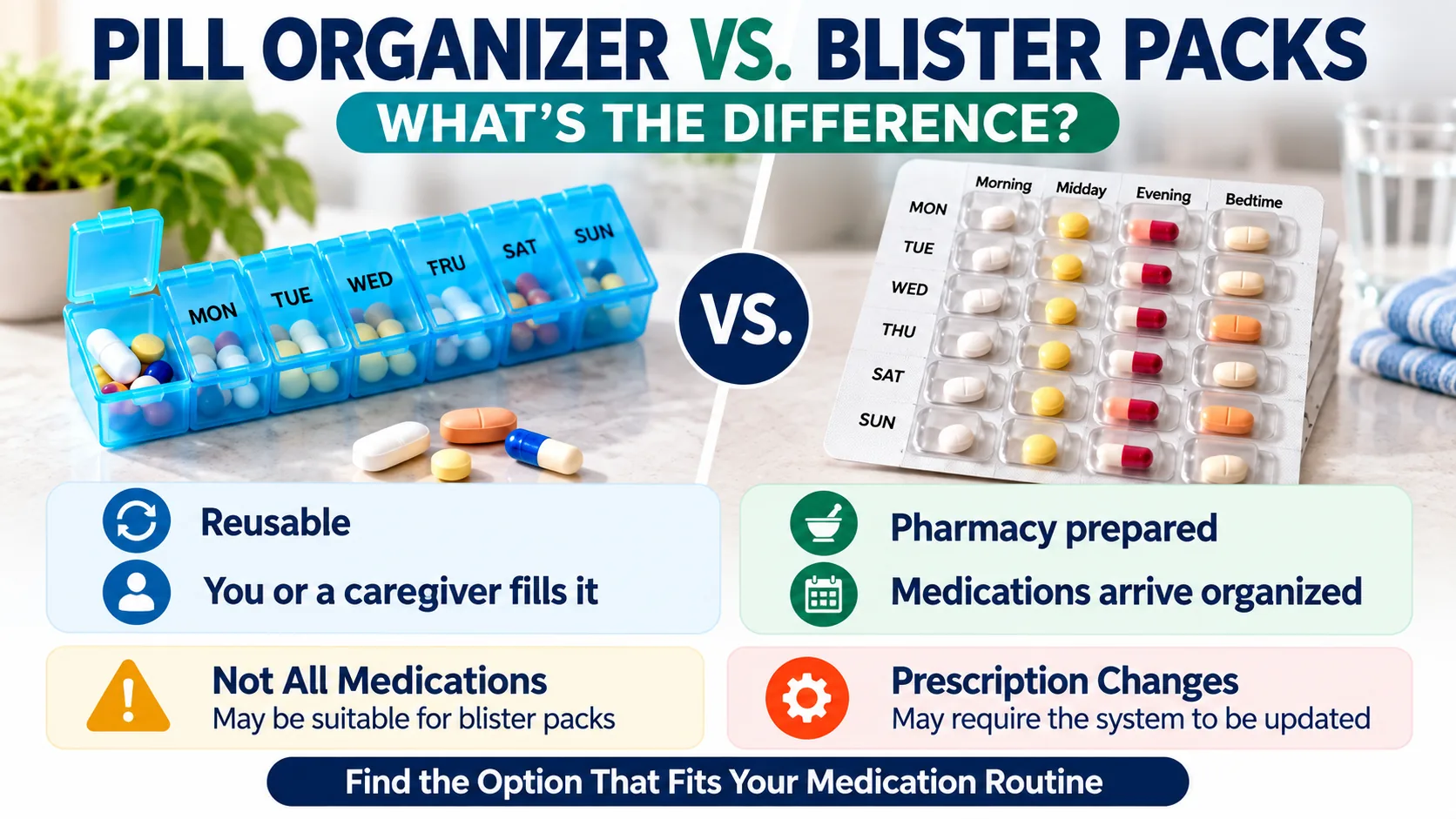
A pill organizer is a reusable container that you or a caregiver fills with medications. Pharmacy-prepared blister packs contain eligible medicines already arranged in sealed compartments according to your prescribed schedule.
The main differences are who prepares the medications, how the packaging is used, and what needs to happen when a prescription changes. Neither option is automatically the right choice for everyone.
Key Takeaways
- An organizer needs to be filled accurately and refilled for the next cycle.
- Pharmacy-prepared packaging reduces sorting at home for the medicines included.
- Some medicines may need to stay in separate or original packaging.
- Prescription changes can affect both your current setup and future packages.
What Is a Pill Organizer?
A pill organizer, sometimes called a pill box, separates medicines into reusable compartments. Designs may have one compartment per day or several for different medication times.
The patient, a caregiver, or sometimes a healthcare professional fills it. Ask your pharmacist which medicines are suitable and which compartment arrangement fits your prescribed schedule.
What Are Pharmacy Blister Packs?
Pharmacy-prepared blister packs organize eligible medicines into sealed compartments before you receive them. The package identifies the scheduled day or time for the medicines it contains.
This article discusses pharmacy-prepared medication-management packs, rather than every type of manufacturer blister packaging.
Pill Organizer vs. Blister Packs: What Are the Key Differences?
| Feature | Pill organizer | Pharmacy blister packs |
|---|---|---|
| Preparation | Usually filled by the patient or caregiver | Prepared by the pharmacy |
| Container | Reusable compartments | Sealed compartments used as prepared |
| Schedule | Day or time compartments, depending on the organizer | Eligible medicines arranged by prescribed schedule |
| Sorting at home | Usually needed | Less sorting for included medicines |
| Prescription changes | Existing contents may need updating with guidance | Current packaging needs review; future packs may need updating |
A Simple Example
Someone taking several ongoing medicines might use a weekly organizer filled at home. With pharmacy-prepared packaging, eligible medicines arrive already sorted. Both organize a schedule, but the preparation process differs.
What Are Some Advantages of a Pill Organizer?
Reusable Container
The organizer can be filled again after each cycle.
Different Compartment Arrangements
You can choose a design that fits the number of prescribed medication times. Someone still needs to fill it correctly and keep it current.
What Are Some Advantages of Pharmacy Blister Packs?
Medicines Arrive Organized
For included prescriptions, pharmacy preparation reduces the need to sort medicines yourself.
What Research Shows
A systematic review and meta-analysis found that packaging interventions improved medication adherence overall and reported larger effects in blister-pack studies. However, publication bias, differences between studies, and limited reporting of health outcomes restrict how the findings should be interpreted.
Other reviews also identify limitations in the evidence. These findings do not establish that blister packs are the better choice for every patient.
Can Every Medication Go Into a Blister Pack?
Not necessarily. Suitability depends on the medicine, dosage form, directions, and storage or stability requirements.
Your pharmacist can review what may be packaged and explain how to manage medicines that stay separate. Ask before moving medicines into a reusable organizer as well.
What Happens if a Prescription Changes?
A new medicine, changed dose, or discontinued prescription can make an existing organizer or pack inconsistent with your current instructions.
Contact your pharmacist for guidance about medicines already organized or packaged. Do not guess how to rearrange them. The pharmacy may also need to update future packages.
Which Option Might Fit Your Medication Routine?
Discuss your medicines, prescribed times, caregiver support, ability to fill an organizer accurately, and how often prescriptions change. The appropriate approach depends on your routine and the medicines involved.
Can Medication Synchronization Be Used With Blister Packs?
Medication synchronization coordinates eligible refill dates. Packaging organizes eligible medicines by prescribed schedule. The two services may be used together when appropriate.
Questions to Ask Your Pharmacist
- Which medicines are suitable for an organizer or pharmacy packaging?
- Which medicines need to stay separate?
- What should I do if my prescription changes?
- How will a newly prescribed medicine be handled?
- Could synchronized refills fit my routine?
ABC Drugs offers Dispill, blister packs, pill packs, and synchronization for eligible prescriptions. Learn more about Medication Packaging & Management at ABC Drugs.
Frequently Asked Questions
Are pill organizers and blister packs the same thing?
No. An organizer is reusable and needs filling. Pharmacy-prepared blister packs arrive with eligible medicines organized in sealed compartments.
Do I fill pharmacy-prepared blister packs myself?
No. The pharmacy prepares the medication-management packs discussed here before providing them to you.
Can all my medications go into blister packs?
Not necessarily. Your pharmacist needs to assess medication-specific requirements and explain any medicines that remain separate.
What if my prescription changes after the packs are prepared?
Contact your pharmacist for instructions about your current packs and any changes needed for future packaging.
Sources & References
This article draws on medication-organization guidance and systematic reviews of packaging interventions. Research findings are presented with their limitations.
- MedlinePlus — Keeping Your Medicines OrganizedOrganizer arrangements and discussing a suitable system with your pharmacist.
- Conn VS, Ruppar TM, Chan KC, et al. — Packaging Interventions to Increase Medication Adherence: Systematic Review and Meta-analysisCurrent Medical Research and Opinion, 2015. Packaging effects on adherence and limitations including publication bias and sparse health-outcome reporting.
- Mahtani KR, Heneghan CJ, Glasziou PP, Perera R — Reminder Packaging for Improving Adherence to Self-administered Long-term MedicationsCochrane, 2011. Evidence for selected patients and the need for further research.
- Boeni F, Spinatsch E, Suter K, Hersberger KE, Arnet I — Effect of Drug Reminder Packaging on Medication Adherence: A Systematic Review Revealing Research GapsSystematic Reviews, 2014. Reporting gaps and limitations on firm conclusions.